

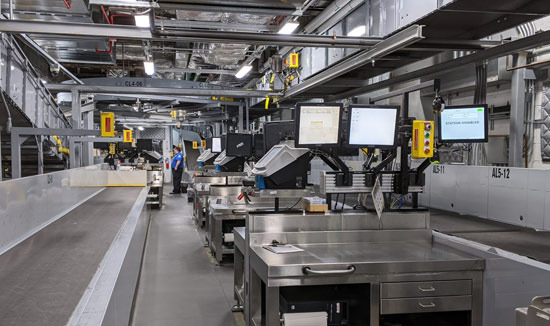
When working as a baggage handler at Chicago O'Hare Airport, you encounter all kinds of people.
So when I talk to Koreans working at the airport, most say, "I hardly see any Koreans and I'm doing just fine."
But how well do these people speak English? It's a bit ambiguous. For those who are not second-generation, it's hard to say they are fluent, but it's also not accurate to say they can't speak at all. One thing is certain.
"They speak the English necessary for their jobs accurately."
Many people think that you need to be good at English to live in the U.S., but that's not necessarily true.
The important thing is not grammar or pronunciation, but 'situational response ability.'
For example, airport staff don't all speak like natives. Instead, they communicate the necessary information quickly and accurately.
"Where does this luggage go?", "What gate has changed?", "What should we prioritize if there's a delay?" That's the kind of language they use.
They don't speak at length. They get straight to the point.
Among Koreans who have succeeded, they don't aim for perfect English.
Instead, they make repeated patterns their own. By using the same expressions in similar situations, they naturally become familiar with them.
For instance, in logistics, construction, restaurants, and hospital assistance, it's all the same. The English they use in their jobs is precise.
However, outside of work, their speech diminishes. They don't engage in unnecessary conversations.
There's an important point here. It's not about "English that avoids conflict" but rather "English that endures."
At first, you obviously won't understand everything. But instead of just letting it go, you keep pushing through.
If you don't understand, you ask again, if you make a mistake, you correct it, and even if you're embarrassed, you keep trying.
After repeating this for months or years, at some point, your ears will start to open up. Then comes the speaking.
Realistically speaking, if you hardly see any Koreans, you should at least be able to handle phone calls without any issues.
Reading and writing emails is basic, and you should reach a level where you can understand simple jokes.
That said, you don't need to speak like a news anchor. You just need to be at a level where the other person can work comfortably.
Many people find this more difficult than it is, but once you experience it, it's not that hard. You can narrow down the scope.
Another important factor is attitude. A more significant problem than not speaking English is having an "I don't want to try" attitude.
At the airport, such people are immediately noticeable. They don't ask questions, they brush things off, and they repeat mistakes.
On the other hand, those who keep asking questions, even with limited English, improve quickly. This difference plays a significant role in the U.S.
Active communication is more important than perfect sentences.
Ultimately, to thrive while working in U.S. government or infrastructure jobs, it's not about being good at English but knowing how to use it well.
Using the expressions necessary for your job accurately, asking questions when you don't know, and making it your own through repetition.
Once that builds up, you can manage without relying on the Korean community.
Many people get scared before they even start. "What if I can't speak English?"
But in the field, there are far more people who have succeeded by improving their English as they go than those who were good at it from the start.
Very few people are good from the beginning. In the end, those who endure and learn remain.
 USAToday







 ollege Mom |
 Helpful Life Stories |
 prixon74 |
 Balancework |
 Make My Day |
 moo moo |

 Trot King News |

 Tennis City |
  sunny7 |
  Questions about firearms while living in America |
  Shoot Me |
  mochifox |
  zucchini |
  Anna Life |
  Exciting FM Radio |
  pet dog |
  toodin |
  rosed |
  DeArizona Blog |
  river9 |
  Pronunciation Yo |
  nuvex11 |
  Living in Florida |
  axelon47 |
  lumbus |
  Texas Migration Story |