

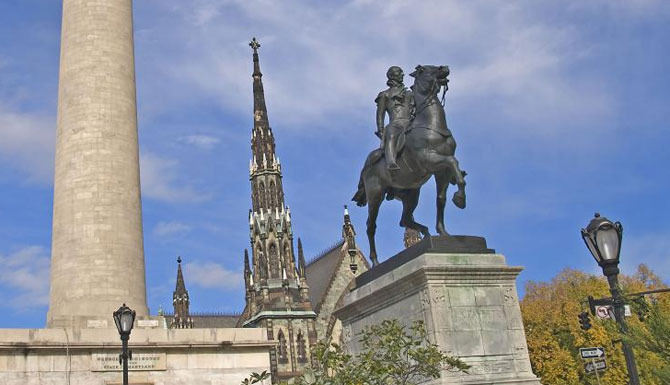
When I first saw the Washington Monument in Baltimore, I thought, 'Why is that tower from Washington D.C. here?' But it turns out this is the oldest Washington Monument in the United States.
It was built 30 years earlier than the one in D.C. This tower was started in 1815 and completed in 1829, and it is the first monument dedicated to George Washington, the first President of the United States. Standing tall on a hill in the Mount Vernon area of Baltimore, its white glow was quite impressive from afar.
At first, I thought it was just a white stone column, but as I got closer, I noticed the intricately carved patterns and the bronze door, with a statue of General Washington at the top. That statue is the symbol of this tower. It depicts George Washington returning command of the military to Congress after the Revolutionary War.
The pose of lowering the sword and extending one hand felt like more than just a simple hero's stance; it seemed to show the dignity of a leader relinquishing power. In that sense, this tower felt like not just a 'monument of victory' but a 'symbol of humility.' Looking up from below, the height is so great that your head almost tilts back. It stands about 178 feet (approximately 54 meters) tall, which is truly an amazing structure considering it was built in the early 1800s.
At that time, there were no elevators, so it was all built by hand, stone by stone. Inside, there is a narrow spiral staircase, and after climbing about 227 steps, you reach the observation deck. I visited in the morning when there weren't many people, so the only sounds I heard while climbing the stairs were my footsteps and breathing echoing off the stone walls, creating a strangely serene atmosphere.
The view of downtown Baltimore from the observation deck was truly impressive. Directly below was Mount Vernon Square, surrounded by old church steeples and red brick buildings. Among them, the Johns Hopkins Peabody Institute, the Maryland State Library, and nearby small parks stood out.
Even in the heart of the city, there was a very calm and artistic atmosphere. Right in front of the Washington Monument, there was a round fountain and benches, where I sat down to enjoy a coffee and take a break. The sound of classical music drifting from nearby buildings made me lose track of time and linger there for a while.
As I walked around the base of the tower, I noticed reliefs related to the Revolutionary War. Scenes from the battlefield, soldiers marching, and Washington leading the Continental Army were intricately carved into the stone, making it feel as if the air from 200 years ago still lingered.
Another interesting point is that this tower has not only served as a monument but has also been used as a gathering place for citizens throughout the ages. On Independence Day or Veterans Day, events are held here, and in winter, a Christmas tree lighting ceremony takes place, bringing local residents together to celebrate. Hearing such stories made me realize that it is not just a relic of the past but a 'living symbol' even today.
The Washington Monument in Baltimore is much smaller and quieter than the massive obelisk in Washington D.C., but it has a human warmth to it. It embodies a warm respect rather than grand authority, and it feels more like 'the heart of this city' than a tourist spot.
Before leaving, I looked up at the tower once more. The Washington Monument is a place that, while not extravagant, gives a deep resonance.





 mygoddess blog |
 Information on All Regions of the United States |
  maryland park |

 frostpup |
  Korean Mom |
  My NYC |
  moo moo |
  Mr Oh |
  forevergee |
  festival |
  manchester |
  constant |
  Leapfrog Move |
  vibranto |
  Tora Tora |
  yellowbutter |
  Dolly |
  US Embassy |
  NYC saladbar |
  Finding Superfoods |
  lightyear |
  song bang |
  vexomo |
  Indiana Jones |