

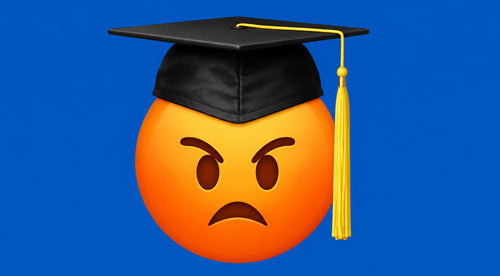
This year, speakers at U.S. college graduation ceremonies were booed for talking about AI.
One person said, "AI is the next industrial revolution," and was met with boos from the students, while another remarked, "AI is changing the game even now," and when the atmosphere turned cold, they retorted, "Just accept it."
The reason for this booing is that while adults say in their graduation speeches, "AI is a wonderful tool," the very people who might lose their first jobs to AI are the graduates themselves.
So why does this matter to people like us? I was struck by the discussion about salaries.
A university research team gave an AI like ChatGPT the same resume for a medical specialist in Denver, Colorado, changing only the gender, and asked, "What salary should I ask for?" The AI suggested $400,000 for the male and only $280,000 for the female. This is said to be one of the most significant disparities in salary inquiries.
The resumes were identical, but just a two-letter difference of 'male' or 'female' led to a recommendation to lose $120,000 a year.
If I think about my daughter following this kind of advice while job hunting, it's hard to feel good about it, right?
Consider the ten years of tuition she has spent studying medicine and all the nights she has worked hard.
The reason this happens is that AI is not some intelligent deity.
It's a machine that has read and mimicked decades of text available on the internet.
If the world has historically paid women less, AI naturally learns to say, "Women earn less" without a second thought.
Old biases are automatically copied behind a clean screen.
What's more frightening is that when a person does this, people might think, "Oh, that's discrimination," but when a machine does it, everyone believes it's objective.
However, newspapers say, "Young people today are not against AI; they want better technology, and they even collect scrap to build their own computers."
While the sentiment is nice, it's honestly a trivial statement. Making something as a hobby is completely different from changing the trends that large companies push for profit.
So asking companies to "be nice and listen to the voices of young people" won't bring about change.
This industry runs on 'fast' rather than 'good.' Departments that focus on ethics and fairness are the first to be cut, and speed always wins. Plus, it's incredibly tough for recent graduates to find jobs.
The unemployment rate for new graduates is significantly higher than the overall average, and at some schools, when students went for career counseling, they were told, "Since machines read resumes anyway, you should let a chatbot write yours."
Given this situation, it's actually strange that there aren't boos at graduation ceremonies.
So my conclusion is this: the boos from the students are not childish tantrums but rather a pretty accurate signal.
However, what we can do as parents is neither to say, "Stay away from AI because it's scary" nor to say, "Everyone else is using it, so you should too."
We should tell them not to blindly trust the answers AI provides and to question them, especially for important matters like salary or career paths, and to always ask a person for advice.
Just because a machine says something neatly doesn't mean it's correct; that one piece of advice can be a solid foundation for our kids.
 MrsPinkberry
 Squid Q
 coastalvibemaker1994







 Ari Songhan American Immigration Life |
 Bearded Strawberry Smoothie |
 Heart Ticker |
 Duck Duck Go |
 Arong and Darong |
 Korean News American Blog |
 All About Cars |
 humpday sonata |
 Nuchuhan Exploration BLOG |
 Information on All Regions of the United States |
  Mr. Largo |
  breezem |
  Omelet Rice for Strength |
  Vermont Capt |
  Softy |
  solid90 |
  waltz |
  Ohio Ohayoung Hello |
  parlon |
  Shoot Me |
  Michigan Enthusiast |
  festive |
  You Turn Me On |
  Supplemental Security Income (SSI) Information |
  Sams Market |
  ansdal |
  VVV 80 |
  BIODOCTOR NEWS |
  Gold Bar |
  Tamfa Fan |