
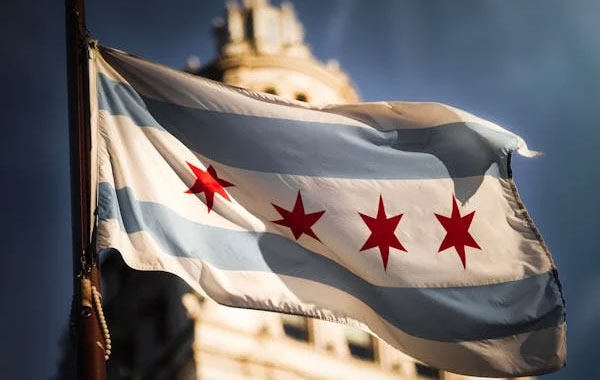
The Chicago Flag is a simple yet striking design, representing the city's history and identity as a prominent icon. It is often mentioned as one of the most beautiful city flags in the world, embodying the pride of its citizens.
The Origin of the Chicago Flag
The Chicago Flag was created through a design competition held by the city of Chicago in 1917.
- Designer: The final design was submitted by a designer named Whitney Smith.
- Purpose: The goal was to create a flag that could simply yet effectively capture the city's history and symbols.
- Official Adoption: It was officially adopted by the Chicago City Council in 1917.
Key Elements of the Flag Design
The Chicago Flag consists of a white background with two blue stripes and four red stars. Each element carries its own symbolic meaning.
1) White Background
- The white represents the three main areas of Chicago:
- North Side
- West Side
- South Side
- This symbolizes that Chicago is a city made up of diverse neighborhoods and cultures.
2) Two Blue Stripes
- Top Blue Stripe: Represents Lake Michigan and the North Branch of the Chicago River.
- Bottom Blue Stripe: Represents the South Branch of the Chicago River.
- These blue stripes emphasize that Chicago is a city surrounded by rivers and lakes.
3) Four Red Stars
The red stars represent significant historical events and the identity of the city.
First Star (Fort Dearborn):
- Symbolizes the beginning of Chicago in 1833 and commemorates Fort Dearborn, a major military post at the time.
- The six points of the star represent Chicago's key strengths (transportation, commerce, agriculture, etc.).
Second Star (Great Chicago Fire):
- Symbolizes the Great Fire of 1871.
- This star commemorates the city's remarkable recovery and growth.
Third Star (World's Columbian Exposition):
- Commemorates the World's Fair held in 1893.
- This shows that Chicago has grown into a city recognized internationally.
Fourth Star (Century of Progress Exposition):
- Symbolizes the fair celebrating a century of progress held in 1933-1934.
- Represents Chicago's innovation and industrial development.
The Evolution and Symbolism of the Flag
Starting with two stars in 1917, the Chicago Flag gradually added stars to commemorate historical events.
- Initially, it began with two stars (Fort Dearborn and the Great Fire) and was finalized with four stars in 1933.
- Each star, along with the blue stripes and white background, represents Chicago's history and culture, instilling pride in its citizens.
Cultural Value of the Flag
The Chicago Flag is not just a symbol; it has become an important part of the city's culture.
1) A Beloved Flag Among Citizens
- The Chicago Flag is widely used in various forms such as shirts, hats, and tattoos.
- This shows that citizens take pride in their city's identity and feel a sense of unity through the flag.
2) Use in Media and Pop Culture
- In movies, TV dramas, and sports events, the Chicago Flag frequently appears as a symbol representing the city.
- Sports teams (like the Chicago Bulls and Chicago Cubs) have also created logos and uniforms inspired by the flag's design.
Comparison with Other City Flags
The Chicago Flag, while simple, is regarded as one of the most beautiful city flags in the world due to its striking design and deep symbolism.
- Exemplar of City Flags: It is often mentioned as one of the best-designed flags among North American city flags.
- Distinction from Other Cities: Instead of complex patterns, it adopts a simple and symbolic design, enhancing its visual impact and recognition.
The Chicago Flag transcends being a mere city symbol; it can be considered a work of art representing Chicago's culture and identity. The elements contained within it serve as important symbols that remember the city's history and instill pride in its residents.








 Khan Film Blog Production |
 Illinois Mom |
 Rice Shop Uncle BLOG |
 allstar realty |
 Enjoyable American Life Diary |
  Tonky |
  viroma |
  cookie |
  Live and that's it |
  Alright Twain |
  eatontown blog |
  HAWAII Korean Church News |
  Amore |
  linex |
  Balancework |
  laro90 |
  MEDBIO American Doctor Blog |
  SWAT TEAM BLK |
  DREAM BIG |
  frostbite |
  330 Forever My Love |
  El Dorado |
  dralix58 |
  Gorama Round |
  Skydiving |