
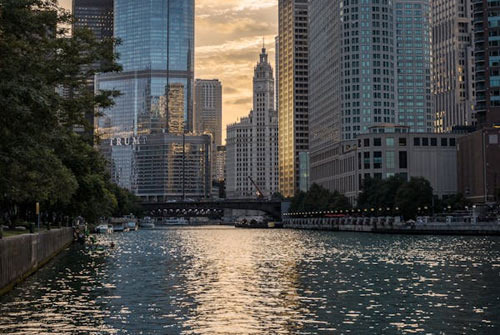
The Chicago River is a natural, historical, and cultural symbol representing Chicago. This river has played a crucial role in the formation and development of Chicago, and today it is an essential element that adds to the city's unique landscape and charm.
Overview of the Chicago River
- Length: Approximately 156 miles (about 251 km)
- Classification: Composed of the North Branch, South Branch, and Main Stem
- Location: Runs through downtown Chicago and connects to Lake Michigan
History and Development of the Chicago River
1) Early History
- The Chicago River was originally an important transportation route for Native Americans, including the Potawatomi.
- The flat terrain around the river became an ideal settlement for early explorers and settlers, leading to the birth of the city of Chicago.
2) Canals and Connections
- 1825: With the completion of the Erie Canal connecting New York and Lake Michigan, the Chicago River became a major transportation route in the Midwest.
- 1848: The completion of the Illinois and Michigan Canal, which connected the Chicago River to the Mississippi River, significantly boosted the city's economy.
3) Environmental Innovation: River Flow Reversal
- Late 19th Century: Rapid industrialization in Chicago led to severe pollution of the river.
- 1900: A large-scale engineering project was undertaken to reverse the flow of the river from Lake Michigan to the Illinois River to address environmental issues.
- This innovative project reduced water pollution and transformed the river into an important urban resource.
- The project was regarded as a global engineering achievement at the time.
Modern Chicago River
1) The River and Urban Life
The Chicago River has become an important part of urban life beyond just being a waterway.
- Chicago Riverwalk:
- A pedestrian-only area developed along the downtown, featuring cafes, restaurants, parks, and art spaces in harmony.
- A popular walking and leisure space for locals and tourists.
- Water Activities:
- Various activities such as kayaking, boat tours, and picnics on the river provide recreational space for city dwellers.
2) Tourist Attractions
The Chicago River connects several iconic landmarks of the city, offering unique experiences to visitors.
- Chicago River Architecture Tour:
- A tour that allows visitors to admire world-class skyscrapers, a must-do for tourists visiting Chicago.
- Bridges:
- Numerous movable bridges crossing the river are symbols of Chicago's engineering and history.
- Bridges like the Michigan Avenue Bridge contribute to the city's unique landscape.
Iconic River Dyeing Event
Every year on St. Patrick's Day, the Chicago River is dyed green, symbolizing the city's traditions and festive culture.
- History: This event began in 1962 and has now become a world-famous event.
- Method: The river is dyed green using edible dye, making it environmentally friendly.
- During the festival, the riverbank is bustling with residents and tourists, allowing everyone to feel the city's vibrancy.
Chicago River and the Environment
- The Chicago River has long faced pollution issues, but efforts to restore the river ecosystem are ongoing today.
- Eco-Friendly Projects:
- Through riverbank redevelopment and ecological restoration, biodiversity around the river is being restored.
- Includes water purification and sustainable infrastructure projects.
- Economic Importance: It played a central role during the industrialization era and today serves as a hub for tourism and recreation.
- Cultural Significance: It is a place to experience the city's history through architecture, bridges, and the Riverwalk.
- Community Pride: Events centered around the river, such as St. Patrick's Day celebrations, strengthen the identity and pride of Chicagoans.
The historical significance and modern utility of the river make Chicago an even more attractive city, and it will remain a central resource for the city in the future.



 Khan Film Blog Production |
 Rice Shop Uncle BLOG |
 Illinois Mom |
 allstar realty |
 Nanana Nanana Nanana |
  Korean Mom |
  My NYC |
  moo moo |
  Mr Oh |
  forevergee |
  festival |
  manchester |
  constant |
  Leapfrog Move |
  vibranto |
  Tora Tora |
  yellowbutter |
  Dolly |
  US Embassy |
  NYC saladbar |
  Finding Superfoods |
  lightyear |
  song bang |
  vexomo |
  Indiana Jones |