

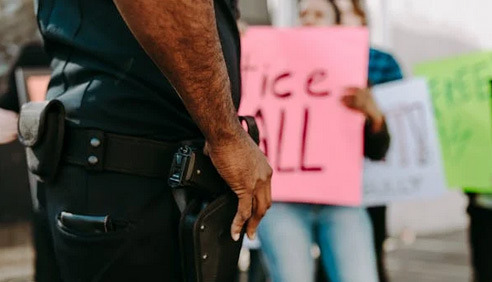
Recently, as the immigrant rights protection protest in downtown LA escalated into violent clashes, the question arises, 'Why does LA experience riots so often?'
The protest erupted when over 100 immigrants were arrested near City Hall, leading to an explosion of anger among residents, and thousands of demonstrators took to the streets.
It started as a typical protest but gradually intensified, with some participants blocking highways and setting vehicles on fire.
The police responded with rubber bullets and tear gas, and eventually, the National Guard was deployed. However, upon closer inspection, this is not merely a reaction to enforcement.
LA is a city that has historically experienced repeated riots.
The Watts riots of 1965 and the Rodney King riots of 1992 are prime examples. Back then, police brutality, racism, and unfairness in the law were the triggers.
The well-known Rodney King riots began on March 3, 1991, when LAPD officers were filmed excessively beating African American man Rodney King during his arrest on the highway. This footage spread nationwide, inciting public outrage.
However, all four officers were acquitted in court. When this news was officially announced at the end of April 1992, riots broke out across LA, particularly in South Central, a predominantly Black area. The anger ignited not only within the Black community but also among other minority groups. The six days of riots from April 29 to May 3 resulted in 63 deaths, 2,383 injuries, over 10,000 arrests, and property damage exceeding $1 billion.
The riots also hit Koreatown hard. The LAPD prioritized major retail stores and affluent areas for suppression, effectively neglecting Koreatown..
In response, Korean merchants and residents took matters into their own hands. Armed individuals with guns, pipes, and shotguns climbed onto building rooftops to stand guard—these individuals are referred to online as "Rooftop Koreans." Korean merchants stated, "The police provided no help, so we had to protect ourselves." One merchant emphasized, "We never fired first. The police ran away..." highlighting their claim of self-defense..
The 1992 LA riots were not solely born from anger against police violence. They were an explosion of accumulated racial tensions, economic and social inequalities, and distrust in public authority. Particularly, Korean immigrants had to resort to self-defense symbolized by the 'rooftop,' raising fundamental questions about the social safety net in America.
So why do such events frequently occur in LA?
The first reason is the diverse mix of races and classes. When Black, Latino, Asian, and White communities coexist, various conflicts arise, increasing the potential for explosions. Issues like income disparity and differences in educational opportunities often serve as the sparks for these conflicts.
The second factor is the role of the police. The LAPD has long been known for its aggressive tactics. Frequent use of force and accusations of racial bias have been noted. As citizens lose trust in the police, even minor incidents can escalate into large-scale resistance.
The third factor is economic inequality. While LA has areas with luxurious homes, it also has many regions with high poverty rates. Areas lacking jobs or with poor healthcare and educational services tend to have heightened dissatisfaction, which can manifest in violent protests.
Another crucial factor is the media. Nowadays, a single video can capture national attention. When protest scenes spread through social media, people in other regions also become outraged and sympathetic. This can lead to larger protests and more provocative actions.
Lastly, political conflict cannot be overlooked. In this situation, the governor opposed the deployment of troops, while former President Trump ordered a tough response. Such political tensions exacerbate on-the-ground tensions, ultimately contributing to the escalation into riots.
Ultimately, the riots in LA are not mere coincidences but a manifestation of the inherent issues within the city's structure. Accumulated grievances, a breakdown of trust, and repeated oppression all combine to create an explosion. Protests may be momentary, but the underlying issues remain unresolved, which is the most unfortunate aspect.
LA is a city where race, class, and power structures are intricately intertwined. With a large and diverse immigrant population, economic and social conflicts are simultaneously common. Police overreach, unfair law enforcement, and economic deprivation fuel the flames of protest, while the media turns this into a national public discourse.
The recent events are not merely protests against immigration enforcement. They are the result of an explosion of the urban power structure, federal-state authority disputes, and the distrust and inequality within a multicultural society. The fact that we have not learned from the lessons of the Watts riots in 1965 and the Rodney King incident in 1992 makes it feel serious that LA is still caught in the cycle of the same problems.





 Toaster Pizza Magic Show |
 US Embassy |
 fortbliss |
 Folding Instructions |
 yentra |
 Weekend Movie Blog |
 Beauty, Health, Lifestyle Blog |
 coloradoman |
 Superman Cat Blog |
 novapixel |
  DREAM BIG |
  frostbite |
  330 Forever My Love |
  El Dorado |
  dralix58 |
  Gorama Round |
  Skydiving |
  dreamport |
  Yellow Snowman |
  velvetnom |
  Anytime Journey |
  Mrs. Duluth |
  jaxter |
  Atlanta Mama |
  Baguette Blog |
  Tan Sol |
  Korean Mom |
  My NYC |