

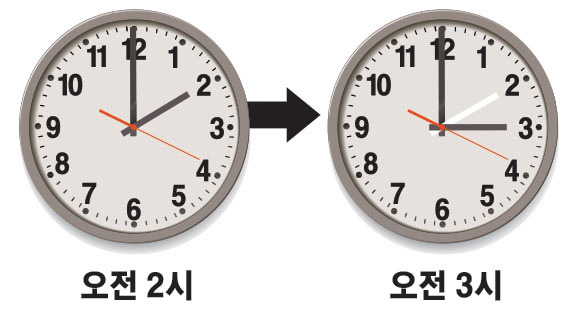
It's that time of year again when we change our clocks twice a year.
Daylight Saving Time starts this Sunday, March 8.
At 2 AM on the 8th, we will set our clocks forward one hour. 2 AM will become 3 AM.
It sounds simple, but your body may not feel that way. As you go about your day, you might feel like you have lost an hour.
When Daylight Saving Time begins, the time difference between the U.S. West Coast and Korea will also change.
Previously, there was a 17-hour difference, but now it will be reduced to 16 hours.
This is an important detail for those who communicate with family or business contacts in Korea.
In the first few days, you might find yourself thinking, "Huh? What time is it in Korea now?" and recalculating.
The real issue is with our bodies. Most people experience something similar on Monday mornings.
The alarm goes off, but your body doesn't feel like it's morning at all.
This is because you are actually in a state of having slept one hour less.
Research shows that right after the start of Daylight Saving Time, there is an increase in drowsy driving and decreased concentration.
Among workers, you often hear comments like, "Isn't this basically stealing an hour from us?"
Despite this, the reason Daylight Saving Time continues is that it allows us to make better use of daylight in the evening.
In the past, it was also aimed at reducing electricity usage. Nowadays, with LED lighting and improved energy efficiency, many believe the benefits are not as significant, but it remains a tradition.
In the U.S., discussions about abolishing this system have been ongoing for quite some time.
In fact, several states have proposed legislation to simply keep the time fixed.
However, the problem is that we need to synchronize time nationwide. If some states observe Daylight Saving Time while others do not, it could disrupt aviation, broadcasting, and financial systems. So, despite the discussions, it remains in place. There have been long-standing claims about the interests of certain industries, as later sunsets change consumer behavior.
Retail and dining industries are often mentioned in this context. When it's still light outside after work, people are more likely to go to shopping malls or restaurants instead of heading straight home. In fact, analyses show that increased foot traffic in the evening leads to higher sales. Therefore, some sectors argue that maintaining Daylight Saving Time is economically beneficial.
The leisure industry also tends to favor Daylight Saving Time for similar reasons. Longer days mean more time for golf courses and outdoor sports facilities. After work, people have more time to play a round or exercise, which clearly benefits related industries.
Interestingly, most Americans do not like Daylight Saving Time.
Especially when it starts in the spring, almost everyone complains. The question, "Why do we have to change the clocks?" is repeated every year.
Conversely, when the time extends by an hour in the fall, the reaction is somewhat better. At that time, people feel like they can "sleep an extra hour."
However, there is one positive aspect. When Daylight Saving Time begins, the evenings definitely become brighter. There are many days when the sun is still up after work. Just going out for a walk or taking a stroll around the neighborhood during that extra time makes the day feel a bit longer. Compared to the winter months when the sun sets so early, it definitely feels different.
In the end, the conclusion is that while we grumble about it, we adapt once again.







 prixon74 |
 Balancework |
 Make My Day |
 viroma |
 eatontown blog |
 Only Dentalbay |
 Tony Park |
 Grow Your Gut Bacteria Well |
 U.S. Weather Bureau News |
 Swift Falcon |
  venture |
  SPAM 101 |
  choi family |
  zoryan |
  cloud0 |
  SKy Face |
  wonder |
  Dragon Lee |
  productionblog |
  What can make money? |
  Oklahoma Hoya OK |
  Roman Pan |
  USALATU BLOG |
  Sunshine Blog |
  Minnesota Small Business |
  Strawberry Pancake Warrior |
  amolayo |
  korvon |