

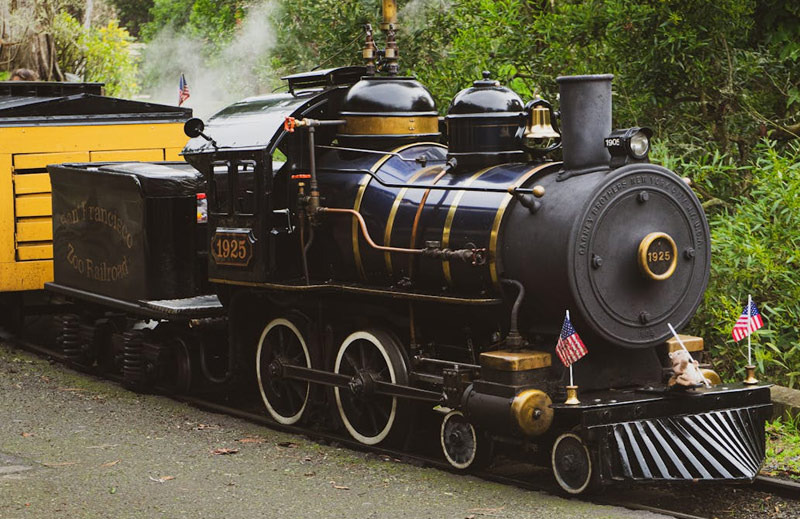
In 19th century America, railroads meant more than just a means of transportation. In particular, the construction of railroads led by steam locomotives had a tremendous impact on the westward expansion of the United States, changing the distribution of industry and population, as well as urban development patterns.
The westward expansion of the United States primarily intensified in the 19th century. As the population in the eastern regions grew, people seeking farmland or new opportunities gradually moved westward. The government also promoted the expansion of U.S. territory and western settlement by advocating the idea of 'Manifest Destiny.' Thus, with various territorial acquisitions, including the Louisiana Purchase (1803), the territory expanded westward, leading more people to take an interest in the western regions.
However, in an era when there were no means to efficiently move across vast lands and transport goods, traveling long distances by horse and wagon was not easy. Additionally, one had to face vast plains, deserts, and rugged mountain ranges. Despite these challenges, economic opportunities such as the gold rush (California Gold Rush of 1848) and abundant pastures and farmland attracted people to the West.
From the late 18th century to the early 19th century, steam engine technology rapidly developed in Europe and America. The ability to generate power by using steam produced from burning coal allowed machines to operate. Based on this, steam locomotives were introduced in various countries, including Britain, from the early 19th century, and soon the railroad business became vibrant in the United States.
Particularly, the United States felt a strong need for railroad construction to quickly and efficiently connect its vast lands. From the 1820s to the 1830s, railroads began to be laid primarily in the eastern and midwestern regions, and as the desire for westward expansion grew, a massive railroad project was initiated to extend the tracks to the Pacific coast. Thus, the 'Transcontinental Railroad' was born, connecting the east and west of the United States.
The Transcontinental Railroad is considered a decisive turning point in the development of the American West. Starting in 1863, two major railroad companies, 'Union Pacific' and 'Central Pacific,' began laying tracks from the east and west, respectively.
-
Union Pacific (UP): Constructed westward from Omaha, Nebraska
-
Central Pacific (CP): Constructed eastward from Sacramento, California
The two companies competed to complete the construction under harsh conditions. At that time, many Chinese and Irish laborers were employed, and due to the need to traverse the rugged Rocky Mountains and Sierra Nevada, there were many casualties.
Finally, on May 10, 1869, the Transcontinental Railroad was fully connected at Promontory Summit, Utah, with the driving of the 'Golden Spike.' This event remains a highly symbolic moment in American modern history. With the establishment of a railroad connecting the Atlantic and Pacific coasts, travel across the American continent was reduced from months to just a few days.
With the railroad laid down, the movement of people to the western regions exploded, and new cities and towns sprang up everywhere. In this process, the logistics of mineral resources and agricultural products, which were difficult to transport by road and wagon, could now be moved quickly and in large quantities by rail. Naturally, industries such as manufacturing, commerce, and mining grew, and cities developed along the railroad lines.
-
Urban Formation: Populations gathered around railroad stations, leading small towns to grow into large cities. Notable examples include Chicago, Denver, and Salt Lake City.
-
Agricultural Development: Agricultural products produced in the fertile lands of the Midwest and West could be easily transported to the eastern metropolitan areas by rail.
-
Mining Development: The rapid transportation of mineral resources (gold, silver, copper, etc.) from the western regions to the east greatly boosted the mining industry.
-
Expansion of Consumer Culture: Businesses could sell products nationwide through railroads, leading to the development of catalog mail-order sales (Sears, Montgomery Ward, etc.).
Steam locomotives played a dominant role in railroads from the 19th century to the mid-20th century, but as technology advanced, diesel and electric locomotives emerged. From the mid-20th century, steam locomotives were gradually replaced and began to decline. However, the impact of steam locomotives on the development of the American West remains unforgettable. Even today, in some areas, steam locomotives are operated for tourism purposes or displayed in museums.
The history of the development of the American West and steam railroads is so closely intertwined that they cannot be separated. Without the railroads, the exploration, urbanization, and industrial development of the vast western lands would not have occurred so rapidly. The completion of the Transcontinental Railroad economically propelled the United States forward and significantly changed people's lifestyles.
Thus, steam engine technology and railroad construction are not merely inventions of transportation but are representative examples of expanding a nation's geographical, economic, and cultural horizons. If you are interested in traveling to the American West or American history, visiting railroad heritage sites and experiencing the remnants of the old western era can be an enjoyable experience.







 Korean Mom |
 novapixel |
 Peter Pan Pet |
 horse |
 Sunset Oregon |
 Physical Laws and Science |
 Grow Your Gut Bacteria Well |


 laro90 |
  MEDBIO American Doctor Blog |
  SWAT TEAM BLK |
  DREAM BIG |
  frostbite |
  330 Forever My Love |
  El Dorado |
  dralix58 |
  Gorama Round |
  Skydiving |
  dreamport |
  Yellow Snowman |
  Toaster Pizza Magic Show |
  velvetnom |
  Anytime Journey |
  Mrs. Duluth |
  jaxter |
  Atlanta Mama |
  Baguette Blog |
  Tan Sol |