

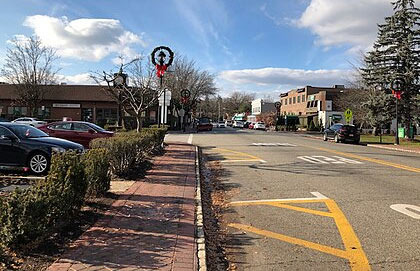
Cresskill is known as a quiet residential area in Bergen County, but when it comes to transportation, it is quite conveniently located.
On the map, it may seem densely populated with forests and houses, but once you navigate the road network, you quickly realize that access to New York and major freeways is faster than expected. This neighborhood is not an urban transportation hub but rather a 'stable residential area that relies on cars.' So while it may seem like a slow neighborhood, commuting, schooling, and daily activities are actually quite convenient.
First, let's look at access to New York. The main route from Cresskill to Manhattan is via the George Washington Bridge (GW Bridge). Typically, you head south from Cresskill, passing through Fort Lee or Englewood Cliffs to enter the bridge. There are several routes in this process, but the most commonly used connector by drivers is US-9W.
9W is a road that runs along the Hudson River; although it has few lanes, when traffic is light, it allows for smooth driving with less stress. Conversely, during peak commuting hours, many choose RT-4. RT-4 connects to the Fort Lee commercial area and has shopping malls and supermarkets, making it very convenient. However, since you have to pass through the commercial area, the perceived speed can vary depending on the time of day.
Access to the freeways is centered around I-95 and I-80. I-95 is a major route connecting the East Coast, directly continuing after crossing the George Washington Bridge. If you take this road, it is easy to reach New York, southern New Jersey, the Paramus shopping area, and the eastern coastal region.
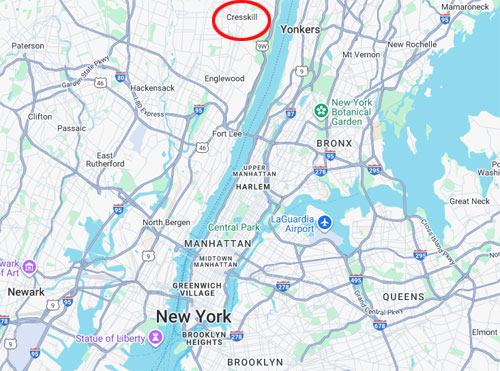
In short, it can be described as a 'skeleton road' that penetrates the metropolitan area. I-80 is also important, connecting central and northern New Jersey to the west, and further extending to Pennsylvania. Residents of Cresskill combine these two freeways with RT-4 and RT-9W to create their commuting routes. They do not only live with their eyes on New York; internal travel within New Jersey is also convenient, which is an advantage of having a 'balanced road environment.'
Cresskill does not have a train station, but the bus routes are relatively well organized. By taking an NJ Transit bus, you can easily reach Fort Lee, Englewood Cliffs, and the Manhattan Port Authority Terminal.
Buses have frequent schedules during commuting hours, making it easy for workers to use, and students also find it convenient for traveling to schools or academies in New York. However, the absence of a train station leads to some disappointment for those who find driving inconvenient. Therefore, retirees or households that do not use cars sometimes supplement their living arrangements with train access from nearby neighborhoods.
The internal roads of the residential area reflect the atmosphere of Cresskill. There are many narrow and winding roads, and speed bumps are present everywhere, making it difficult to speed. Instead, pedestrian safety is well maintained, and the entire neighborhood is composed of a 'slow road environment centered around residential areas.' Movement within the neighborhood is quiet and leisurely, but once you hit the outer roads, you can drive at a faster pace, creating a balance in the area.
In summary, while Cresskill does not have freeways running through the middle of the neighborhood, it can be described as a 'quiet transportation hub' with excellent connectivity to the outskirts. The stable mobility based on cars is an advantage, and it also has good access to New York supplemented by buses. Therefore, it is not simply a 'small and quiet neighborhood,' but a place where one can enjoy both tranquility and convenience.
For those seeking a relaxed lifestyle in New Jersey while wanting to move quickly when needed, Cresskill might be a good choice.


 moo moo |
 ultron78 |
 garlic bread |
 Sugar Cream Door Bulletproof Noodles |
 urbanmint |
 forestcloud |
 andrew park |

 Lemon Kim |
 springw |
  Tonky |
  viroma |
  cookie |
  Live and that's it |
  Alright Twain |
  eatontown blog |
  HAWAII Korean Church News |
  Amore |
  linex |
  Balancework |
  laro90 |
  MEDBIO American Doctor Blog |
  SWAT TEAM BLK |
  DREAM BIG |
  frostbite |
  330 Forever My Love |
  El Dorado |
  dralix58 |
  Gorama Round |
  Skydiving |