

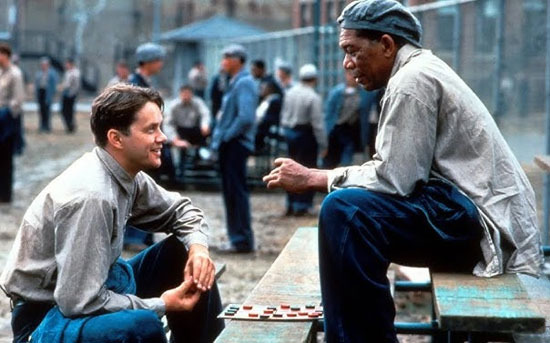
The movie The Shawshank Redemption did not receive the immense acclaim it enjoys today when it was released in 1994.
However, as time passed, it gained a reputation through word of mouth, becoming known as a "life-changing film" for many, and it is now remembered as the movie that beautifully explains the word 'hope' worldwide.
This work is one of the four stories included in Stephen King's collection Different Seasons, corresponding to the 'spring' segment. Although it is now regarded as a life-changing masterpiece, it did not attract significant attention in terms of box office or buzz at the time of its release.
However, Ted Turner, the founder of CNN and a mogul in the cable TV industry, purchased the secondary rights and repeatedly aired it on his channel, spreading the word, which resulted in immense popularity through the video and DVD market and TV broadcasts.
At the Academy Awards, it was nominated in seven categories, including Best Picture, but it did not win due to strong competition from films like Forrest Gump, Pulp Fiction, Legends of the Fall, The Lion King, and Speed. Nevertheless, it ranked 72nd in AFI's list of the greatest Hollywood films of all time, receiving a higher rating than Forrest Gump, which swept the Academy that year.
In South Korea, it has been dubbed and aired multiple times on terrestrial TV, and it is still a film that you can often encounter while flipping through cable movie channels. This is why it is famous for being a movie that once you start watching, you can't stop until the end.
The core message of this film is encapsulated in a single line from a letter Andy leaves for Red: "Hope is a good thing. Maybe the best of things. And no good thing ever dies." Shawshank is a physical prison, but the real prison the film depicts is the human heart.
In the lives of corrupt wardens, violent guards, and prisoners conditioned by rules for decades, most people gradually give up on themselves. But Andy is different. Instead of succumbing to his environment, he quietly creates his own world. He expands the broken library into a knowledge space for the prison and shares beer with fellow inmates, giving them a moment of humanity. The scene where he takes control of the speaker and plays Mozart's opera symbolically shows that the prison walls cannot confine the human spirit.
The film also presents another important theme: 'taming.' Brooks, an elderly man who was paroled after over 50 years in prison, could not adapt to the outside world and ultimately took his own life. For him, freedom was not joy but fear. This is because the prison's rules had become his entire life.
Red is also in the same perilous situation. He advises Andy not to have hope, claiming that hope is dangerous and only brings disappointment. However, Andy continuously tells Red about a different world, gradually shaking his heart. Ultimately, Red makes a different choice than Brooks.
Andy's escape is one of the main reasons this film has been loved for so long. His escape is not flashy like an action movie. It is a slow and quiet struggle, chipping away at the wall with a rock hammer for 20 years. While others laugh and give up, he scrapes the wall every single day and sends the stone dust to the yard.
Finally, on a stormy night, the scene where Andy emerges from the sewer and walks into the rain with his arms wide open remains an iconic moment in film history. It is not just an escape; it is the moment a human reclaims his life.
The message this film gives us is still relevant. Within the invisible walls of company, money, relationships, and social responsibilities, we each live trapped in our own Shawshank. This is why the film is special; everyone harbors a peaceful place they wish to reach in their hearts. The film asks us: Will you be busy dying or busy living?
In the final scene, Red repeats a simple phrase as he goes to meet Andy: "I hope."
This line quietly tells us what the only value humans must hold onto in a world where despair has become the norm. The Shawshank Redemption is not just a prison movie. It is a story about human dignity and hope, whispering to us that at the end of perseverance, the sea is waiting for us all.




 Day by day |
 Kitchen Ideas |
 Iowa Egen Aunt |
 Beauty, Health, Lifestyle Blog |
 Always Atlanta |
 U.S. Weather Bureau News |
 Things to know |
 Premium Gas Camp |
 Texas Real Estate Blog |
 action blog 101 |
  US Embassy |
  Korean Mom |
  My NYC |
  moo moo |
  Mr Oh |
  forevergee |
  festival |
  manchester |
  constant |
  Leapfrog Move |
  vibranto |
  Tora Tora |
  yellowbutter |
  Dolly |
  NYC saladbar |
  Finding Superfoods |
  lightyear |
  song bang |
  vexomo |
  Indiana Jones |