
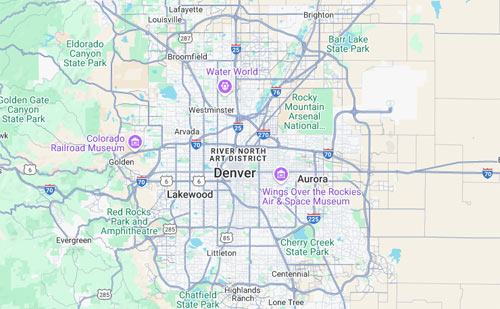
Denver is the central hub and major city of Colorado, with a well-established transportation system, but traffic issues are becoming more prominent due to population growth and urban expansion. Here's a summary of Denver's traffic information and current status.
Road Network and Freeways
Denver is connected by several major freeways and highways, making intercity travel relatively convenient.
- Interstate 25 (I-25): A major road that runs north-south through Denver, connecting Colorado Springs and Fort Collins.
- Interstate 70 (I-70): Runs east-west through Denver, connecting the Rocky Mountain region and Kansas.
- E-470 and C-470: Toll roads that connect the outskirts of Denver, convenient for bypassing the city center or traveling to the airport.
- US Highway 36: A road connecting Denver and Boulder, also known as the "Denver-Boulder Turnpike."
Public Transportation
- RTD (Regional Transportation District)
- A public transportation service connecting Denver and surrounding areas, operating buses and light rail.
- The light rail covers 10 lines, reaching downtown Denver and suburban areas, with Union Station being a major hub.
- Flatiron Flyer: A rapid bus (BRT) route connecting Denver and Boulder, allowing for fast and convenient travel.
- Denver International Airport Connection
- The A Line light rail connects downtown Denver (Union Station) to Denver International Airport (DIA) in about 37 minutes.
Traffic Status
Denver is one of the cities in the U.S. experiencing increasing traffic congestion.
- Commute Times:
- Traffic occurs during rush hours, with I-25 and I-70 showing severe congestion during these times.
- In particular, the downtown section of I-25 and the DTC (Denver Tech Center) area experience serious bottlenecks.
- Major Congestion Areas:
- I-25: The section from downtown Denver to DTC.
- I-70: Congestion occurs on weekends due to vehicles heading to ski resorts in the Rocky Mountains.
- US-36: Congestion between Denver and Boulder, especially during weekday commute hours.
- Commute Time:
- The average commute time in Denver is about 25-30 minutes, similar to the average in other major U.S. cities.
Ways to Reduce Traffic Congestion
- Carpooling and Public Transport:
- Using RTD light rail and rapid buses can help avoid congested areas.
- Using carpool lanes (HOV lanes) allows for faster travel with two or more passengers.
- Utilizing Toll Roads:
- Toll roads like E-470 and C-470 tend to have less congestion, making them worth using for quicker travel.
- Using Traffic Apps:
- Real-time traffic information can be checked on Google Maps, Waze, or CDOT's COTrip.org.
Parking Information
- Downtown Parking:
- Parking rates in downtown Denver range from $1 to $3 per hour, and while there are many parking lots, spaces can fill up quickly in popular areas.
- The mobile app ParkMobile allows for advance reservations or payments for parking spaces.
- Denver International Airport Parking:
- There are short-term and long-term parking options, and using the A Line light rail can save on airport parking costs.
Denver does face notable traffic challenges, especially during rush hours. The city ranks among the more congested in the U.S., with key problem areas on Interstate 25 (I-25) and Interstate 70 (I-70).
- I-25 bottlenecks: These occur near downtown Denver and the Denver Tech Center (DTC), where high commuter traffic leads to regular gridlock.
- I-70 congestion: This highway faces significant delays, especially in the downtown corridor and during weekends when travelers head to or from the mountains for recreation.
Drivers in the Denver metro area can spend substantial time stuck in traffic, with peak commute hours—typically 7:00–9:00 AM and 4:00–6:00 PM—being the most problematic. Efforts are ongoing to expand infrastructure and improve public transit options, but traffic remains a challenge for residents and visitors alike.







 Your Curiosity Resolved |
 LIZ Legal Information Blog |

 coloradoman |
  Jean Claude Bundang Blog |
  DREAM BIG |
  frostbite |
  330 Forever My Love |
  El Dorado |
  dralix58 |
  Gorama Round |
  Skydiving |
  dreamport |
  Yellow Snowman |
  Toaster Pizza Magic Show |
  velvetnom |
  Anytime Journey |
  Mrs. Duluth |
  jaxter |
  Atlanta Mama |
  Baguette Blog |
  Tan Sol |
  US Embassy |
  Korean Mom |
  My NYC |