

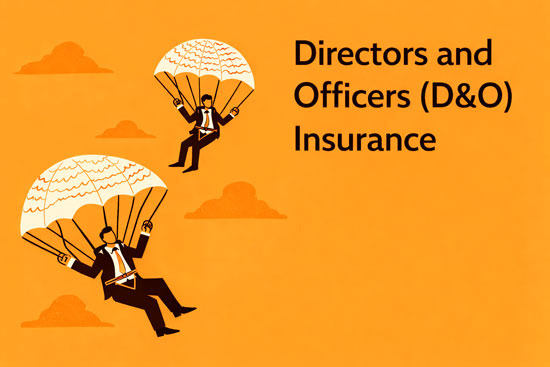
When you have even a little experience running a company or hear about startups or corporations from those around you, there's one term that always comes up.
That's D&O insurance. The name itself tells you what it is: Directors and Officers Liability Insurance.
This is essentially "insurance that protects personal assets from being seized if a lawsuit is filed while doing company business."
Why is this important? In the U.S., lawsuits often come not against the company but against the directors or officers personally.
For example, if a company undergoes a merger or acquisition and the outcome is unfavorable, shareholders will immediately file a lawsuit.
"The directors made poor judgments, causing the company to suffer significant losses. Compensate us."
In this case, it's not just the company that is implicated; the directors' personal names are also included.
If the directors make a wrong decision, it's not just the company's money at stake, but the personal assets of the directors, like their homes or bank accounts, are at risk.
This is where D&O insurance comes into play.
This insurance is structured in three parts.
The first is Side A.
This protects individuals directly when the company cannot indemnify them.
For instance, it protects individuals when the company has gone bankrupt or is legally unable to cover costs.
The second is Side B.
This involves the company paying the costs upfront, and the insurance company reimbursing the company later. In simple terms, it's for the protection of the company.
The third is Side C.
This covers the company itself when it is sued. It is particularly used when publicly traded companies respond to shareholder lawsuits.
The coverage is quite realistic. It covers attorney fees, settlement amounts, and judgment amounts.
However, there are important exclusions. Fraud, criminal acts, and intentional insider trading are not covered.
This is the key point. Mistakes or judgment errors are protected, but intentional crimes are not.
One question that arises is about the premiums. There isn't a fixed price for this. It varies significantly based on the company's condition.
For small companies, it typically ranges from $2,000 to $10,000 annually. The coverage limits are usually between $1 million and $3 million.
For mid-sized companies, it can increase to between $10,000 and $50,000. The coverage limits also expand to between $3 million and $10 million.
For publicly traded companies, it's a completely different world.
It starts at $50,000 and can go up to hundreds of thousands, or even over $1 million in extreme cases.
The reason for this difference is due to risk.
Companies right after an IPO, loss-making companies, and industries with high litigation rates like healthcare, finance, and tech, or companies that have recently faced disputes.
Under these conditions, premiums can rise significantly. Conversely, stable companies see lower premiums. If a company is well-established, has stable profits, and no history of lawsuits, it becomes much cheaper.
Another important factor is the deductible.
For example, if the company agrees to cover the first $50,000 or $100,000, the premium will decrease.
In short, small companies are at the level of car insurance, while publicly traded companies are at the level of property insurance.
That's why in the U.S., directors say, "I won't join the board without D&O insurance." It's not just an empty statement.
From a director's perspective, they make decisions for the company, but if the outcome is unfavorable, they could face lawsuits that threaten their personal homes.
D&O insurance is what protects against this risk. Therefore, for those doing business or joining a board in the U.S., it is seen as almost essential.







 crystalo |
 Investment Beginner Company Information Encyclopedia |
 Always Dreaming of Big Success |
 happy 9 |
 coloradoman |
 Conflite Teacher |

 Exploring American Life Information |
 US Home Buying Information Home Insurance |
 Static |
  Star Way |
  American Blog Forge |
  MMORPG Games |
  Then you must be spring |
  Spicy Immigration Life |
  zenvor16 |
  The 2000 |
  toclick |
  wexlin84 |
  Hairy Poppins |
  daisypat |
  Taco Bell Candy Note Blog |
  MintO |
  My Town My Way Blog |
  New Mexico Friends MAX |
  Hajiwon Blog Hair Salon |
  Wicked - Fireyo |
  Seattle - Emerald City |
  new noah |