

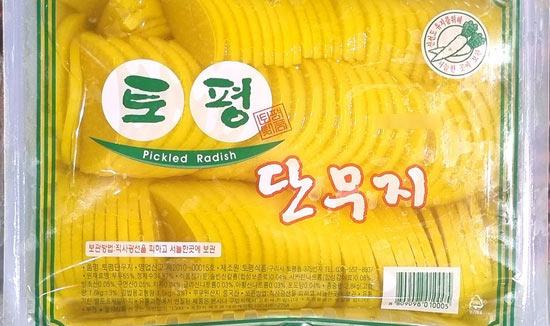
When you eat udon or jajangmyeon, there's something that always comes with it. Do you know what it is? It's pickled radish~
That crunchy, sweet and sour taste.
It's so familiar that you just eat it without thinking, but it turns out this yellow pickled radish has quite a long history.
Pickled radish originally started in Japan. In Japan, it's called 'takuan.'
During the Edo period, there was a monk named 'Takuan Soho' who researched methods for preserving radishes for a long time.
He widely shared the method of fermenting radishes by soaking them in salt and rice bran.
Back then, there were no refrigerators, so it seems that such wisdom was necessary to store food for the winter.
However, the takuan made in those old methods is said to be quite different from the pickled radish we eat today.
It was made through natural fermentation, resulting in a light brown color and a much deeper and stronger flavor.
The bright yellow color we usually see isn't from natural fermentation but is made with turmeric or food coloring.
Pickled radish came to Korea around the time of Japanese colonial rule. The Japanese pickling culture brought takuan along with it.
But did Koreans just eat it as it was? No~ They started to adapt it to their taste. They enhanced the sweetness and sourness, resulting in the pickled radish we know today.
The real popularization of pickled radish is closely related to the dining out culture.
After the 1960s and 70s, as Chinese restaurants began to proliferate nationwide, pickled radish started to be served as a standard side dish with jajangmyeon.
Think about it: when you're eating greasy jajangmyeon and you take a crunchy bite of pickled radish, it refreshes your mouth. So, it seems that the formula 'pickled radish goes with jajangmyeon' was naturally created.
And we can't forget about kimbap. With pickled radish inside, it became not just a side dish but part of the meal.
Honestly, doesn't it feel incomplete if there's no pickled radish in kimbap? That sour and crunchy texture perfectly balances it out.
These days, there are really diverse types of pickled radish.
Thinly sliced half-moon pickled radish, whole pickled radish, crunchy pickled radish, and pickled radish colored with natural ingredients... Personally, I like the crunchy pickled radish~ Recently, products with reduced artificial coloring and health-oriented pickled radish with lower sugar content have also come out.
Pickled radish isn't a particularly fancy food.
But when you think about it, it's been a consistent presence on our dining tables for decades. It started with preservation techniques, grew with the dining out culture, and has now become an essential part of dishes like kimbap and jajangmyeon.
Spicy Pickled Radish SaladWhile pickled radish is delicious on its own, adding just chili powder makes it a completely different side dish.
This spicy and tangy pickled radish salad really awakens your taste buds.
Ingredients
300g pickled radish
1 tablespoon chili powder
1.5 tablespoons vinegar
1 tablespoon sugar or oligo syrup
1 teaspoon minced garlic
1 teaspoon sesame oil
A sprinkle of sesame seeds
How to Make
-
Remove excess moisture from the pickled radish
Slice the pickled radish into bite-sized pieces. Store-bought pickled radish tends to be sweet and moist, so drain it lightly in a colander or press it with a paper towel to remove moisture. This process helps the seasoning absorb well and prevents the flavor from becoming diluted. -
Make the pickling seasoning
In a bowl, first mix the vinegar and sugar well. The key is to establish the sweet and sour base flavor first. Since pickled radish is already sweet, you can reduce the sugar a bit according to your preference. -
Add spiciness
Add the chili powder and minced garlic and mix. If you want it less spicy, you can adjust the chili powder to about 0.5 tablespoons. -
Mix it all together
Add the sliced pickled radish to the seasoning and gently toss. If you mix too vigorously, the pickled radish may become mushy, so gently fold it together. -
Finishing touches
Add sesame oil and sesame seeds, mix once more, and it's done. Let it sit in the refrigerator for about 10-20 minutes for the flavors to meld.






 Yellow Snowman |
 Moscow Kim |
 Seattle - Emerald City |
 self-evaluation |
 Sandiego Auntie |
 victoria 68 |
 Hawaii Tourist Information |

 TEX MEX STAR |
 Vacation on Hawaii |
  DREAM BIG |
  frostbite |
  330 Forever My Love |
  El Dorado |
  dralix58 |
  Gorama Round |
  Skydiving |
  dreamport |
  Toaster Pizza Magic Show |
  velvetnom |
  Anytime Journey |
  Mrs. Duluth |
  jaxter |
  Atlanta Mama |
  Baguette Blog |
  Tan Sol |
  US Embassy |
  Korean Mom |
  My NYC |