

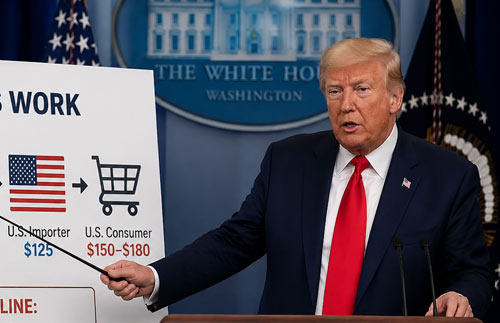
The U.S. Supreme Court has effectively confirmed the legality of the tariffs imposed on China during the Trump administration, resulting in a victory for the government against lawsuits filed by U.S. import companies challenging the tariffs.
This means that the collection of tariffs will continue, but the news about refunds is somewhat confusing.
So, I have summarized the key points of this ruling, the ongoing collection of tariffs, and the issues surrounding refunds in an easy-to-understand manner.
First, the answer to the question "Will tariffs continue to be collected?" is "Yes."
The tariffs that the Supreme Court has upheld were imposed in 2018 by the Trump administration based on Section 301 of the Trade Act of 1974 to retaliate against China's unfair trade practices.
With the Supreme Court dismissing the companies' appeals, import companies will continue to bear tariff costs amounting to approximately $75 billion each year.
So, what exactly is the "tariff refund" mentioned in the news?
This situation arose due to another legal authority that President Trump used when imposing tariffs.
Former President Trump attempted to impose high tariffs on countries worldwide using the International Emergency Economic Powers Act (IEEPA), a law for emergencies, in addition to trade laws.
However, the Supreme Court already stated in February that "the constitutional authority to impose taxes lies with Congress," declaring that the president's interpretation of the emergency law to impose tariffs was 'illegal.'
As a result of this ruling, the government is currently undergoing a massive refund process for approximately $160 billion (about 220 trillion won) in tariffs that were unjustly collected under the emergency law.
In summary, the situation can be divided into two parts.
The tariffs based on the 'emergency law' that were ruled illegal by the Supreme Court will be fully refunded to companies, while the 'China tariffs' confirmed as legal under Section 301 of the Trade Act will continue to be collected without refunds.
This ruling is expected to have a significant ripple effect on future U.S. trade policy.
By recognizing the authority to impose tariffs under trade law, the administration has gained justification for expanding tariffs indirectly.
In fact, the U.S. Trade Representative (USTR) has already proposed imposing additional tariffs of up to 12.5% on 60 countries with inadequate forced labor enforcement.
While companies express concerns that the government is exploiting legal loopholes to wage an endless trade war, this ruling is likely to further solidify the global tariff barriers centered around the U.S.
 MagicPeak78
 DomainToday





 Strawberry Pancake Warrior |
 My Town My Way Blog |
 celion78 |
 Only Dentalbay |
 Snack-like Blog Writing |
 Anjollinya Blog |
 California Dreamer |
 Beauty, Health, Lifestyle Blog |
 Study Abroad Life Know-How Tips |
 Good Karma |
  Key spots |
  Community Cross |
  Oz's Wow Company |
  Wenda |
  Roman Pan |
  Nuchuhan Exploration BLOG |
  Who's watching? |
  What can make money? |
  Egg Steamed Pot |
  New Jersey News Local Stories |
  My Love DS |
  Leapfrog Move |
  US Regional Information Local News |
  Finding Superfoods |
  COLO COLO |
  morixa |
  nero kim |
  USA Hyundai Kia |