
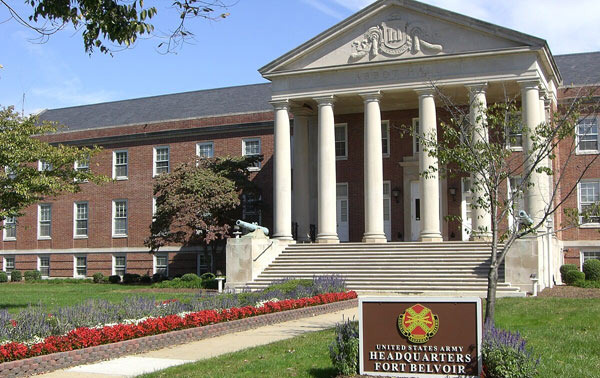
Fort Belvoir, located about 20 miles south of Washington D.C. in Northern Virginia, is well known today as a military base, but it actually has a much older history and complex transformations. Looking out over the banks of the Potomac River, you can feel that this area is not just a military space filled with war equipment and soldiers, but a "living historical space" layered with hundreds of years of time.
The roots of this area date back to the 1740s, starting from land owned by an English noble family. William Fairfax, a relative of Lord Fairfax, who owned large tracts of land in Northern Virginia, built a lavish mansion on this land and named it Belvoir, which means "beautiful view" in French. The mansion symbolized the wealth and influence of the Virginia colonial elite, and it is said that George Washington frequently visited this place. However, the era of the grand Belvoir mansion came to an end when it was destroyed by fire in 1783. Now, only ruins remain, quietly holding the traces of that time.
Throughout the 19th century, this area remained largely unused, but its fate changed when the U.S. government acquired the land in the early 20th century. In 1917, a military engineering training camp was established to prepare for World War I, and it was named Camp A. A. Humphreys. Various military engineering training, including trench construction, bridge building, and chemical warfare preparation, took place here, becoming the foundation for the history of U.S. military engineering.
In 1922, it was upgraded to Fort Humphreys, and in 1935, it regained the name Fort Belvoir in honor of the old Belvoir mansion nearby. Thus, the elegant name of a noble mansion was resurrected as the name of a thoroughly practical military space.
Through World War II, the Korean War, and the Vietnam War, Fort Belvoir's strategic value grew increasingly. It evolved from a simple training ground to a center for military technology, engineering, and logistics information. Especially with the establishment of the Engineer School and intelligence-related facilities, it transformed into a key base for military technology research and education.
In the 2000s, due to the Base Realignment and Closure (BRAC) policy, more agencies moved here, and it has now become an important area, referred to as the "military capital of the information warfare era," housing organizations such as the Defense Logistics Agency (DLA), the National Geospatial-Intelligence Agency, and security and intelligence-related organizations.
Today, Fort Belvoir is one of the largest employers in Fairfax County. Numerous soldiers, civilian employees, and families live both on and off the base, and this vast installation has a significant impact on the local economy. Surrounding businesses, schools, and the housing market revolve around the base, making it an important living foundation for the community, not just a 'military space behind fences.'
Ultimately, Fort Belvoir is an ironic space. A fortress of military technology and information has risen in place of the vanished noble mansion, and a name that once symbolized colonial wealth has now come to symbolize U.S. defense. The ruins of the old mansion are buried in the forest, but its name continues to be used at the forefront of the information age.







 nivex85 |
 dorex |
 Virginia Butterfly Mom |
 Kondae Garusong Blog |
 yentra |
  manchester |
  constant |
  Leapfrog Move |
  vibranto |
  Tora Tora |
  yellowbutter |
  Dolly |
  US Embassy |
  NYC saladbar |
  Finding Superfoods |
  lightyear |
  song bang |
  vexomo |
  Indiana Jones |
  meloncat |
  novapixel |
  mortrix |
  Esther 1983 |
  fortbliss |
  Moscow Kim |