

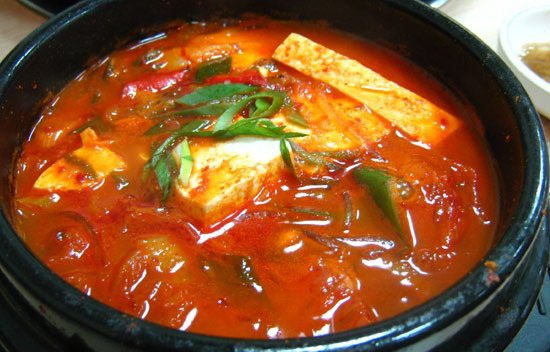
For Koreans, kimchi stew is not just a regular lunch menu that comes to mind when hungry; it is a comfort food that they think of when feeling down while living in America. Whether in New York or Chicago, even after eating steak, pasta, or burgers, there comes a moment when you think, "I should go get some good kimchi stew."
The strength of kimchi stew lies in its simplicity. You don't need special ingredients. Just a bit of aged kimchi and pork, along with half a block of tofu, is enough in one pot. Yet, the flavor is profound.
The taste reminds me of my childhood when my mother often made it, the flavor of the kimchi stew I cooked alone with tuna in my small apartment, and the taste I hurriedly made when I was stressed all come together. So, eating kimchi stew makes me feel like I momentarily return to the past, regardless of my current age or situation.
Another reason kimchi stew is special for Koreans is that it fits any situation. It pairs well on rainy days, is great in the cold winter, and even feels right to eat while sweating in the summer. It's perfect for the day after drinking, and it's the answer when you don't feel like cooking. The fact that you don't have to think about the menu makes kimchi stew a reliable choice.
The key ingredient in kimchi stew is, of course, kimchi. Moderately sour kimchi is better than freshly made kimchi.
When the kimchi starts to sour, that acidity adds depth to the broth. When combined with the fat from the pork, the broth naturally becomes rich. This is why it tastes good even without fancy seasonings.
Here's a simple recipe for kimchi stew that you can easily make at home.
First, the ingredients: about one and a half cups of sour kimchi, 150 to 200 grams of pork shoulder or belly, half a block of tofu, half an onion, one green onion, one tablespoon of minced garlic, one tablespoon of red pepper powder, one tablespoon of soy sauce, a little sesame oil, and about 500 to 600 milliliters of water or broth.
For the cooking method: Lightly coat a pot with sesame oil and stir-fry the pork first. Once the meat is somewhat cooked, add the kimchi and stir-fry together. This step is important. Stir-frying the kimchi softens the sourness and deepens the flavor of the broth. When the kimchi becomes translucent, add the red pepper powder and minced garlic and stir-fry once more.
Next, pour in the water or broth and bring it to a boil. Once it starts boiling, reduce the heat to medium and let it simmer for about 15 to 20 minutes. When the broth is infused, add the onion and tofu and simmer for another 5 minutes. Finally, season with soy sauce and add the green onion to finish. You can adjust the amount of chili or tofu according to your taste.
What's more important than the recipe for kimchi stew is not to rush the cooking. If time allows, the slower you simmer it on low heat, the better the flavor will be. And at the end, adding a teaspoon of sugar enhances the umami flavor.
Ultimately, kimchi stew is a dish that is closer to the heart than to technique. You don't have to try hard to make it well, and there's no worry about failing.
That's why kimchi stew always brings you back. For Koreans, kimchi stew is a timeless flavor and a comfort food that doesn't change as you grow older.





 Yellow Snowman |
 Moscow Kim |
 Seattle - Emerald City |
 self-evaluation |
 Sandiego Auntie |
 nova nova |
 TwinBee |
 Vasila's Newlywed Blog |
 Living in the Eastern United States |
 Tonky |
  viroma |
  cookie |
  Live and that's it |
  Alright Twain |
  eatontown blog |
  HAWAII Korean Church News |
  Amore |
  linex |
  Balancework |
  laro90 |
  MEDBIO American Doctor Blog |
  SWAT TEAM BLK |
  DREAM BIG |
  frostbite |
  330 Forever My Love |
  El Dorado |
  dralix58 |
  Gorama Round |
  Skydiving |