
When the United States purchased Florida from Spain, the area was inhabited by the Seminole tribe, and conflicts with the military gradually intensified, eventually leading to war. During the height of the Second Seminole War, the military established a fort called 'Fort Harvie' in the area to prepare for attacks from the Seminoles. However, after the war ended, the fort was abandoned, and shortly after, when war broke out again with the Seminoles, the military rebuilt the ruined Fort Harvie into a new fort. That fort is what we now know as 'Fort Myers.'
After the end of the Third Seminole War, the fort was abandoned once more. However, with the onset of the Civil War, the fate of Fort Myers changed again. In the summer of 1863, after the Confederacy's defeat at the Battle of Vicksburg, control of the Mississippi River was lost to the Union forces, cutting off the supply of beef to the South. The South sought alternative supply sources and began to graze thousands of cattle in southwestern Florida, particularly around Fort Myers. By the end of 1863, between 1,000 and 2,000 cattle were being transported from Florida to the South each week, but as the Union tightened its coastal blockade, that number gradually decreased.
After the war ended, Fort Myers remained another abandoned fort. However, on February 21, 1866, Captain Manuel Gonzalez settled here with his family, changing the situation. He was well-acquainted with the geography of the area during the Seminole Wars and the Civil War, having spent a long time performing duties delivering military supplies and mail from the fort. After the war, he opened a trading post here, which attracted people and gradually shaped the town into a city.
In the late 19th century, a wealthy businessman from Philadelphia, Hamilton Disston, began developing the area. He dredged the Everglades River to make it easier for steamboats to navigate and improved the drainage system. Thanks to this, Fort Myers began to develop as a commercial and transportation hub, attracting more and more immigrants and investors.
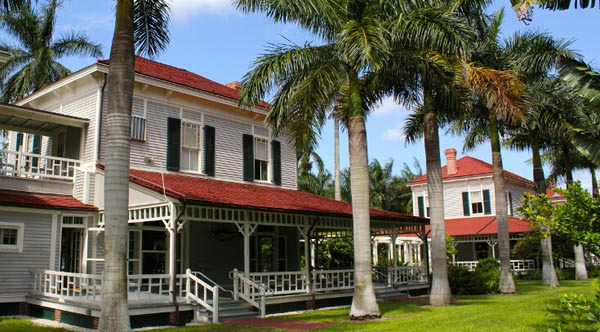
In 1885, inventor Thomas Edison stopped by Fort Myers while sailing along the Florida west coast and was captivated by the area's nature and climate, purchasing 13 acres of land. He built a winter home here and spent every winter with his wife Mina, combining relaxation and research. From this time, Fort Myers began to be known as the 'City of Winter.'
On May 10, 1904, when the Atlantic Coast Line Railroad connected to Fort Myers, the pace of the city's development accelerated rapidly. The opening of the railroad attracted tourists, immigrants, and businessmen all at once, leading to the establishment of shops and accommodations throughout the city, bringing it to life. During World War I, Edison, concerned that the U.S. was relying on foreign rubber imports, collaborated with automotive pioneer Henry Ford to establish a plant research facility in Fort Myers. This facility aimed to develop rubber substitute plants and would later have a significant impact on Florida's industrial base.
Today, as a representative city of southwestern Florida, it remains a unique place where warm climate, historical traces, and Edison's legacy blend together.


 eatontown blog |
 Toaster Pizza Magic Show |
 US Embassy |
 fortbliss |
 Folding Instructions |
 Way to easy |
 FLORIDA Acus |
 Rainbow Bridge to the Sky |
 Joyce 77 |
  Tonky |
  viroma |
  cookie |
  Live and that's it |
  Alright Twain |
  HAWAII Korean Church News |
  Amore |
  linex |
  Balancework |
  laro90 |
  MEDBIO American Doctor Blog |
  SWAT TEAM BLK |
  DREAM BIG |
  frostbite |
  330 Forever My Love |
  El Dorado |
  dralix58 |
  Gorama Round |
  Skydiving |