
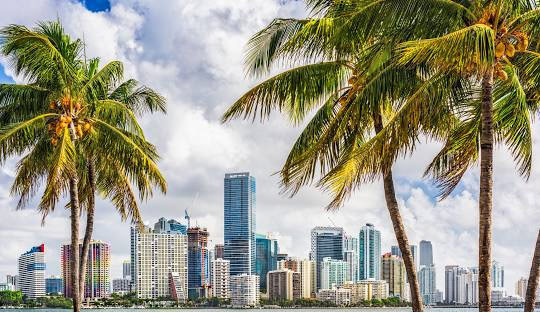
Florida is one of the states with the most unique history in the United States.
Its roots trace back to a long journey that began thousands of years ago on the land of indigenous peoples. Native Americans have lived in Florida for about 12,000 years. Notable tribes include names like Timucua, Calusa, and Apalachee.
They built villages along the coast and rivers, forming communities through hunting, fishing, and simple agriculture. Even today, the Seminole tribe remains in southern Florida, continuing their traditions and culture, and they still have a strong identity within the state.
In 1513, Spanish explorer Juan Ponce de León set foot on this land and named it 'Florida,' meaning 'land of flowers.' He continued his exploration in search of the legendary 'Fountain of Youth,' but ultimately failed amid conflicts with the indigenous peoples.
Afterward, Spain attempted to make Florida its colony, establishing St. Augustine in 1565. To this day, St. Augustine remains the oldest European settlement in the United States, with Spanish-style architecture and cobblestone streets that allow one to feel the traces of that time.
In the 18th century, Spain and Britain alternately ruled Florida. In 1763, Spain ceded Florida to Britain, but it returned to Spain after the American Revolutionary War ended in 1783. This back-and-forth rule between Britain and Spain led to a mix of various cultures and races. During this period, Spanish, English, and indigenous languages were spoken, making Florida a true melting pot of cultures.
In 1819, the United States acquired Florida from Spain through the Adams-Onís Treaty. Thus, in 1821, Florida officially became U.S. territory, and on March 3, 1845, it was admitted as the 27th state. However, this process was not smooth. The U.S. government forcibly relocated the Seminole tribe to the west, leading to three Seminole Wars.
During the 1860s, when the Civil War broke out, Florida joined the Confederacy. At that time, Florida had an agriculture-based economy, supporting the Confederate army through cotton and livestock. After the war, the state began to gradually change its industry and social structure during the Reconstruction period.
Entering the 20th century, Florida began to transform into a completely different place. With the establishment of railroads, tourists flocked from the north, and in the 1920s, a real estate boom led to the construction of resorts and vacation homes along the coast. However, it experienced a brief downturn due to hurricanes and the Great Depression, and during World War II, it regained vitality as a military base.
Today, Florida is the third most populous state in the U.S. Major cities like Miami, Orlando, Tampa, and Jacksonville each have their unique charm, and the multicultural hues created by Cuban, Puerto Rican, and South American immigrants permeate the cities. Economically, various industries, including tourism, aerospace, agriculture, finance, and maritime trade, have developed evenly. At Cape Canaveral, home to NASA's Kennedy Space Center, rockets are still launched, and Florida continues to live as a state where 'the future and tradition of America coexist.'
Ultimately, Florida's history, starting from indigenous villages to Spanish colonies, British influence, and becoming part of the United States, has created the diverse Florida we see today.





 Splendid Mission |


 Taco Bell Candy Note Blog |

 FLORIDA Acus |
  Tonky |
  viroma |
  cookie |
  Live and that's it |
  Alright Twain |
  eatontown blog |
  HAWAII Korean Church News |
  Amore |
  linex |
  Balancework |
  laro90 |
  MEDBIO American Doctor Blog |
  SWAT TEAM BLK |
  DREAM BIG |
  frostbite |
  330 Forever My Love |
  El Dorado |
  dralix58 |
  Gorama Round |
  Skydiving |