

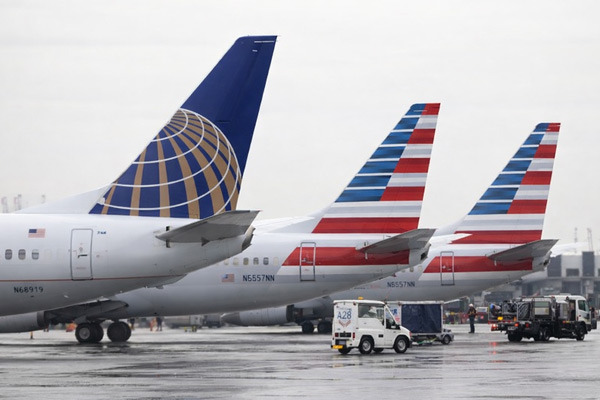
I have lived in Texas for over 20 years. I can't even count how many times I've been in and out of Dallas-Fort Worth (DFW) Airport.
But did you know that DFW Airport is dominated by American Airlines, which controls 83% of the total capacity?
It can practically be considered private property of American Airlines. There is no real competition.
But now, big news has broken.
Reports from Bloomberg and Reuters indicate that United Airlines CEO Scott Kirby is seeking pre-approval for a merger with American.
This means that the number one and number two airlines in the U.S. are potentially merging.
When I first saw this news, I honestly thought, "No way, that can't happen."
But looking at the current atmosphere of the Trump administration...
Transportation Secretary Sean Duffy appeared on CNBC and said, "There is room for mergers in the airline industry."
Trump has said he "likes big deals." This is not a comment to be taken lightly.
Let's first clarify the facts.Currently, the big four in the U.S. airline market are United, American, Delta, and Southwest.
These companies account for 80% of U.S. airline demand. It is already a monopolistic structure.
Airlines like TWA, Continental, Northwest, and US Airways have disappeared into history under the name of mergers.
What has been the result? Competition has virtually disappeared in certain hub cities.
American has 83% in DFW and 89% in Charlotte. United has 82% in Washington Dulles and 75% in Houston Bush Airport.
What these numbers mean is that if you want to go anywhere in those cities, you have no options. If you don't like it, you can just not fly.
What happens if United and American merge in this situation?
About 40% of the total capacity in the U.S. would fall into the hands of a single airline.
In LA, the combined market share of the two airlines is 46%, 45% at three airports in New York, and a staggering 70% at two airports in Chicago.
This means that 7 out of 10 flights in Chicago are operated by one airline.
I fundamentally believe in a market economy. I don't like government interference in business management.However, this case needs to be viewed differently. Because the airline industry is not a typical consumer goods market.
If a monopoly forms at a specific hub, all business travel, tourism, and logistics in that area become dependent on one company's pricing policies and route operations.
Professor Kovalchik from George Washington University made a very accurate statement.
"The increase in prices is a fact that is statistically widely agreed upon, and the concentration at key hubs is at an extreme level," he said.
This is not just the opinion of an economics professor. It is a fact from an antitrust law expert.
Professor Kovalchik believes that even if the DOJ approves it, state governments can legally block it, and foreign governments will also intervene with their own antitrust laws.On the other hand, there is an argument that airline regulation is under federal jurisdiction, so state governments cannot practically intervene.
Just like the Biden administration blocked the merger of low-cost airlines Spirit and JetBlue in court, if the DOJ is determined to fight, it can be stopped. The problem is whether the current DOJ under Trump has that determination.
Moreover, the very discussion of a merger cannot be ignored for its ripple effects on the industry.
There could be a domino effect of restructuring in the industry. Smaller airlines are under even more financial pressure and are cornered.
With the conflict with Iran causing oil prices to skyrocket, the burden of fuel costs is fatal for small airlines.
The United-American merger is seen by many as a decision that undermines the free market rather than strengthening it.Trump said he "likes big deals," but we should not only look at the size of the deal but also consider what it means for the average American consumer.
From a Texan's perspective, the complete monopoly at DFW Airport is honestly concerning.
No matter how much I dislike flying, there should be options to keep prices reasonable.
If this merger goes through, the U.S. airline industry will solidify into an oligopoly with almost no consumer choice.
The only ones who want that are the airline shareholders, and the rest of us... will end up paying higher ticket prices.







 coloradoman |
 Montgomery Mom |
 GOGO SING |
 Hajiwon Blog Hair Salon |
 tartbear |
 xylora |
 Aura-Infused WACAM |

 wendra |
 Dallas Fort Worth DFW |
  novapixel |
  mortrix |
  ollege Mom |
  Esther 1983 |
  Arizona AZ Cowboy |
  fortbliss |
  Moscow Kim |
  My Two Way |
  toastyfox |
  FLORIDA Acus |
  tracker |
  TONTON COFFEE |
  sunrise |
  ultron78 |
  uplifted |
  Folding Instructions |
  same same life |
  USA Hyundai Kia |
  morvex37 |
  BOL SA RAM |