

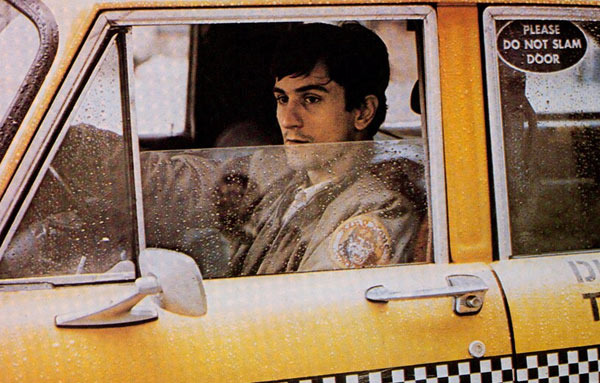
I remember watching the movie Taxi Driver with curiosity about Travis Bickle, played by Robert De Niro, and finding it quite interesting.
Travis is a Vietnam War veteran and a taxi driver. He roams the streets of New York at night, picking up passengers. The problem is that the New York he sees is not the real city, but a distorted version shaped by his anxiety and anger.
What he sees outside the window are only criminals, prostitutes, and corrupt individuals, and he believes that this city is decaying. The film neither argues that this thought is wrong nor right.
Robert De Niro's performance is the key that made this film legendary. Even though he doesn't have many lines, his gaze and gestures convey Travis's isolation. In particular, the scene where he mutters "Are you talking to me?" in front of the mirror reveals his state, as it seems like he is talking to someone but is actually only speaking to himself.
The New York of the 1970s, when Taxi Driver was made, is a completely different city from today. The crime rate was high, and Times Square was filled with porn theaters and bars. The New York in the film is intentionally depicted as dirtier. On a rainy night, neon signs and raindrops on the window reflect Travis's perspective. In this film, the city is not just a backdrop but a device that visualizes the character's mental state.
When I see young people in New York these days, I sometimes think of Travis Bickle from Taxi Driver. Of course, that doesn't mean they are the same. Today's New York is not a city rampant with street crime like in the 70s, nor does it mean that all young people are dangerous.
However, there are certain scenes, expressions, and atmospheres where the shadow of that character seems to overlap. Travis was thoroughly alone in the middle of the city. Nowadays, young people also seem strangely alone in a similar way. There are many people, and the screens are always on, but there is no one to talk to, and it feels like their hearts are even more closed off.
On the subway, everyone is plugged into their earphones and only looking at their phones. It was like that before, but these days it has become even more perfect. There are no expressions. Eyes rarely meet. Even if someone sits next to you, they just pass by like a background. The way Travis nurtured the conclusion that "this city is rotten" while looking out of the taxi at night seems to be growing even faster in today's feeds on smartphones.
The danger of Travis Bickle was not the feeling that the world is bad, but the fact that there was no one to validate that feeling or any outlet to express it. Young people today are similar. On the surface, they seem connected, but in reality, their relationships are thin. Even if they live with a roommate, they go into their rooms and close the door, and even if they have friends, they only connect through messages, and when they talk about anxiety and depression, it often ends with "me too."
Another aspect is the transformation of 'a sense of justice.' Travis believes he must purify the world in his own way. Not all young people are like that today, but in a stimulating city like New York, statements like "this is wrong, and that is rotten, and someone must be punished" can easily grow. It is even easier online. Words that condemn someone spread quickly, and within that, people feel that their anger has meaning.
However, if that process is too fast, there is nothing left in real life that I can do. Ultimately, what remains is the identity of anger and a sense of hatred towards the world. This seems to resemble the swamp that Travis fell into.
The moments when young people in New York resemble Travis Bickle come more strongly from the sight of them walking alone at night. After work, after a part-time job, after school, passing under bright neon signs with empty faces and tired eyes. The more glamorous the city is, the smaller the individual feels. Travis was also someone who became darker while looking at the lights of New York.
Ultimately, when asked why they remind me of him, it is because most young people in New York these days are resembling the 'way of being isolated in a city full of people' too much. But at the same time, it is also an era where isolation can hide in more sophisticated forms. So, I wonder if Travis Bickle, despite being a character from an old movie, occasionally seems to pass by in reality on the streets today.





 Egg Steamed Pot |
 novapixel |
 xylora |
 vegas mom |
 Coco and Lulu |
 newyorker 101 |
 Things to Do to Buy a House |
 Lunch and Dinner Mexican Taco |
 International Court |
 French fries |
  forevergee |
  festival |
  manchester |
  constant |
  Leapfrog Move |
  vibranto |
  Tora Tora |
  yellowbutter |
  Dolly |
  US Embassy |
  NYC saladbar |
  Finding Superfoods |
  lightyear |
  song bang |
  vexomo |
  Indiana Jones |
  meloncat |
  mortrix |
  Esther 1983 |