

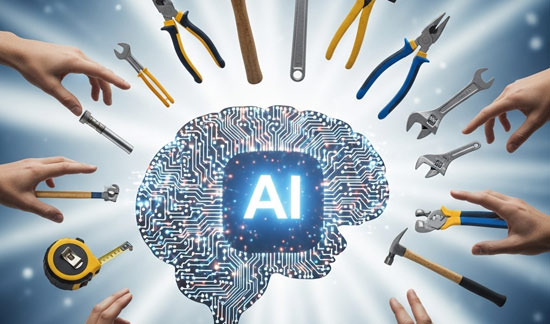
These days, when you hear stories about American workplaces, the phrase "it's more unusual not to use AI" has started to come up.
In fact, recent surveys indicate that one in four American office workers is already incorporating AI into their work.
Previously, this was mostly a topic for developers or data professionals, but now AI has naturally entered typical office jobs like accounting, marketing, sales, and human resources. So, will this ratio increase in the future? Personally, I believe it will inevitably rise. However, it won't spread at the same pace across all job categories.
Starting with office jobs, the answer is almost predetermined. Tasks like drafting emails, summarizing reports, organizing Excel data, compiling meeting notes, and creating presentation drafts are already faster with AI than with humans. Tailoring sentences to match the desired tone, organizing numbers, and structuring materials have now made it more advantageous to be someone who "effectively utilizes AI" rather than just being "skilled at writing."
Especially since American companies are very sensitive to the term productivity, tools that individuals start using on their own can quickly become team standards, eventually leading to the company purchasing licenses. This trend has already begun, and it's hard to go back now.
The issue lies with field jobs. In sectors like restaurants, logistics, construction, manufacturing, cleaning, and transportation, there are still not many opportunities for AI to directly intervene. There are clear practical limitations to having AI cook or completely take over serving in restaurants.
While automation has already entered areas like order kiosks, inventory management, and schedule adjustments, it's hard to say that it replaces actual labor. In the field, the sense of touch, quick judgment, and interaction with people remain crucial. Therefore, the idea of "processing half of the day's work with AI" is still far from reality.
However, there is an important point here. The difference between field workers "not using AI" and "being unable to use AI" is significant. Just looking at restaurant owners in the U.S. these days, they use AI for scheduling employees, adjusting menu prices, and analyzing reviews. While workers may not use it, managers do.
This means that field workers are indirectly affected by AI. Productivity during working hours is increasing, workforce allocation is becoming more efficient, and performance metrics are being managed more precisely with numbers, indicating that change has already begun.
What will this ratio look like in the future? If office jobs are currently at 25 percent, there is a high possibility that it will exceed half within 2 to 3 years.
This is because the structure is shifting towards those who use AI being the norm, while those who do not are falling behind. In contrast, sectors like restaurants or manual labor will likely see a gradual spread rather than explosive growth. It is more likely to seep in through design and management from above rather than direct usage.
Among Koreans living in the U.S., there is a clear pattern in how they use AI. The most common users are undoubtedly office workers and self-employed individuals. Those working in companies tend to utilize AI for email writing, drafting reports, and refining English expressions.
Especially since English is not their first language, there is a high dependency on AI for making sentences sound natural. Self-employed individuals frequently use AI for menu descriptions, advertising copy, responding to reviews, and writing social media posts. In contrast, Korean field workers in kitchens, construction, and logistics still rarely use AI directly in their tasks. However, in management areas like store operations, schedule management, and cost calculations, AI has already naturally integrated.
In my opinion, AI does not change all jobs at once but quietly divides tasks within jobs. Even within the same office job, the productivity gap between those who effectively use AI and those who do not is widening.
The fact that one in four American office workers is already using AI is just the beginning. The real question may be who adapts first to this trend and who can hold out until the end.







 Korean Mom |
 novapixel |
 Peter Pan Pet |
 horse |
 Sunset Oregon |
 American Food Information & Calories |

 Lifestyle Information Search USA |

 What can make money? |
  US Embassy |
  My NYC |
  moo moo |
  Mr Oh |
  forevergee |
  festival |
  manchester |
  constant |
  Leapfrog Move |
  vibranto |
  Tora Tora |
  yellowbutter |
  Dolly |
  NYC saladbar |
  Finding Superfoods |
  lightyear |
  song bang |
  vexomo |
  Indiana Jones |