
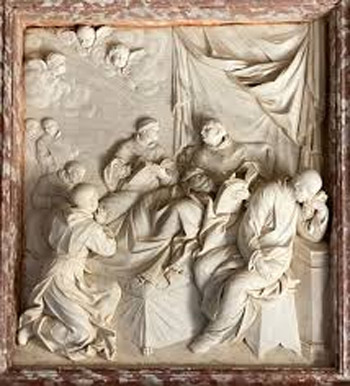
Thomas Aquinas (1225-1274) was a medieval Christian theologian and philosopher, a key figure in Scholastic philosophy.
He emphasized that the philosophy of Aristotle could be integrated with Christian theology, allowing faith and reason to complement each other without conflict.
Aquinas had a significant impact on the development of Christian theology, and his thoughts greatly influenced Western medieval and modern philosophy and theology.
Aquinas argued that faith and reason are not separate realms but rather complementary to each other.
He distinguished between theology and philosophy, viewing theology as the pursuit of truth through faith and philosophy as the pursuit of truth through reason.
Accordingly, he believed that the truth found through faith and the truth found through reason ultimately converge into the same truth.
He claimed that the existence and order of God could be logically proven through reason, laying the foundation for natural theology. One of Aquinas's most famous achievements is his attempt to rationally prove the existence of God.
He argued that the existence of God could be proven in five ways in natural theology.
The first is the 'proof of motion,' which states that every object is moved by some cause, and tracing back the chain of causes leads to the "unmoved mover," which is God.
The second is the 'proof of cause and effect,' which explains that every event requires a cause, and if the chain of causes continues endlessly, a first cause, which is God, is necessary.
The third is the 'proof of necessity and possibility,' which claims that all beings in the world exist out of necessity, and there must be a necessary being, which is God, that makes all these existences possible.
The fourth is the 'proof of perfection,' which explains that when comparing the most perfect things in the world to the standard of perfection, the perfect being that defines it is God.
Finally, the 'teleological proof' argues that nature did not occur by chance but has a specific purpose, and the being that created order and harmony towards this purpose is God.
Aquinas explained moral law and social law according to divine law.
He described how human moral nature and divine law are connected through natural law.
Natural law can be recognized by reason and provides the standard for moral actions that align with divine intent.
He also distinguished between divine law and human law, arguing that law in human society should fulfill God's will.
Aquinas believed that the human soul is immortal and that the soul has a deep relationship with the existence of God.
He aimed for the ultimate goal of the human soul to become perfect in relation to God and ultimately unite with God.
Aquinas sought to integrate Aristotle's philosophy into Christian theology.
He addressed theological topics based on Aristotle's emphasis on 'the importance of reason' and 'the principles of reality,' applying Aristotle's physics, ethics, and logic to theological discussions.
Through Aristotle's rational approach, he aimed to explain Christian doctrine rationally and harmoniously combine faith with reason.
Aquinas's philosophy and theology laid the foundation for Scholastic philosophy and had a significant impact on both medieval and modern philosophy.
His thoughts were recognized as orthodox by the Church and established a standard for theological education, particularly in deep relation to Roman Catholic doctrine. Aquinas's theories influenced not only medieval doctrine but also modern philosophy and science.
The discussions he presented on the existence of God and moral law continue to be significant parts of philosophy and theology today.
Thomas Aquinas was an important philosopher and theologian who expanded the boundaries of philosophy and theology by combining faith and reason.
He systematized Christian theology and provided a deep understanding of human existence, God, morality, and law.
His thoughts have greatly influenced not only medieval philosophy but also modern philosophy and theology, still offering profound insights to many.




 Weekend Movie Blog |
 Beauty, Health, Lifestyle Blog |

 coloradoman |
 Superman Cat Blog |
 novapixel |
  US Embassy |
  Korean Mom |
  My NYC |
  moo moo |
  Mr Oh |
  forevergee |
  festival |
  manchester |
  constant |
  Leapfrog Move |
  vibranto |
  Tora Tora |
  yellowbutter |
  Dolly |
  NYC saladbar |
  Finding Superfoods |
  lightyear |
  song bang |
  vexomo |
  Indiana Jones |