
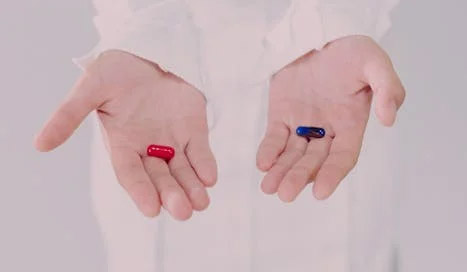
The choice between the red pill and the blue pill in The Matrix raises important questions from a philosophical perspective.
This scene is closely related to various philosophical concepts such as Plato's Allegory of the Cave, Descartes' doubt, and Hegel's dialectics.
Through this, we can explore the meaning of facing facts, the importance of free will, and the justification of one's reality.
In The Matrix, if Neo chooses the blue pill, he continues to live in the virtual world of the Matrix as it is, and if he chooses the red pill, he learns the truth and faces the reality outside the Matrix. This choice fundamentally symbolizes the crossroads between seeking truth and choosing comfortable ignorance.
If he chooses the blue pill, he will not know the truth and instead live a comfortable and unconscious life. This is similar to Plato's Allegory of the Cave. Plato argued that people live only seeing shadows inside the cave, and to recognize the truth, they must leave the cave. Taking the blue pill means living in a state where one only sees shadows in the cave and does not know reality.
On the other hand, choosing the red pill means knowing the truth, but that truth may be painful, uncomfortable, and harsh. This emphasizes the importance of knowing the truth from an epistemological perspective. Knowing the truth allows one to escape ignorance, but it also comes with responsibilities and pain. Philosophically, this shows that the process of seeking truth is never easy.
The choice between the red pill and the blue pill also raises questions about free will and decision-making. Neo must realize himself and decide whether to choose the truth or pursue comfort. This scene symbolically addresses the issue of free will. A person has the freedom to pursue truth, but that is not necessarily a comfortable choice, and it raises philosophical concerns about the responsibilities that come with that choice.
Through free will, Neo can choose the truth, but this also signifies great change and sacrifice in his life. This relates to Kierkegaard's philosophy of decision. He argued that free choice is the essence of human existence, and true freedom is making choices while enduring pain.
Choosing the red pill ultimately means accepting the pain of truth, which connects to Socratic philosophy. Socrates emphasized the importance of awareness of ignorance and the attitude of seeking truth. He said, "Knowing that you know little is true wisdom," and that the more one knows the truth, the more painful it becomes, but it leads to the development and wisdom of human existence.
In The Matrix, the truth comes with unavoidable pain. The real world is much more brutal and harsh than the virtual world within the Matrix, but facing that reality is the process of gaining self-awareness as a human being. Knowing the truth means losing comfort, and instead, freedom and responsibility follow.
The story of The Matrix is also deeply related to epistemology (the relationship between what we know and what is real). Descartes emphasized the process of doubting everything and confirming one's existence through his famous saying, "I think, therefore I am." In The Matrix, Neo initially doubts what to believe, but ultimately finds the truth through the process of realizing his existence and reality.
This resembles a Cartesian approach to the process of doubt and the search for truth. Inside the Matrix, people are trapped in virtual reality, but the moment they recognize and accept reality, they come to a new realization of their existence and live as real humans, no longer mechanical beings.
The choice between the red pill and the blue pill in The Matrix goes beyond simply choosing between two options; it represents the quest for truth, free will, and the conflict between reality and illusion.
The red pill is a choice that seeks truth and freedom, but it comes with pain and change.
The blue pill offers a comfortable life and the peace of ignorance, but ultimately it is a choice to give up truth and freedom.
These two choices symbolize the fundamental conflict of human existence and pose philosophical questions about how we accept truth and perceive reality.
Ultimately, the decision that comes with responsibility is one that must be made by oneself.






 Weekend Movie Blog |
 Beauty, Health, Lifestyle Blog |

 coloradoman |
 Superman Cat Blog |
 Sunny's Travel in America |
  round1 |
  Way to easy |
  musicque |
  road98 |
  Churros Train Conductor |
  gleeful |
  Burbank Lee |
  Olivia's Blog |
  Bushing Around Life |
  Active |
  Cherokee Rose |
  Kor. Master |
  Holey Moley |
  Conflite Teacher |
  Hodong Prince Over Flex |
  Mist inn |
  citrus pop |
  Onion Ring |
  phoenixia |
  viewtop |