

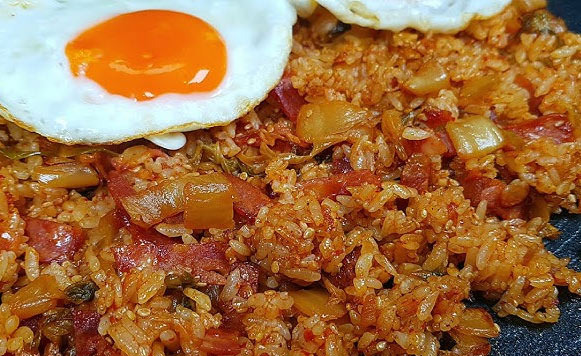
Kimchi fried rice is one of the easiest dishes to make at home. You can quickly whip up a meal with just kimchi and rice, even if you don't have any special ingredients in the fridge. That's why kimchi fried rice is a go-to option for many households when they ponder, "What should we eat?"
The method of preparation is simple.
First, take about one cup of kimchi, measured with a paper cup, and chop it into appropriate sizes on a cutting board. If chopping the kimchi separately seems like a hassle, you can use pre-chopped kimchi meant for side dishes.
Now, heat a frying pan over medium heat. If you plan to add unprocessed meats like pork or ham, sauté them in the pan first. Once the meat starts to change color to gray, add a little more cooking oil and toss in the kimchi to stir-fry together. Be careful not to add too much oil, as it can dilute the unique flavor of the kimchi; a light coating in the pan is sufficient.
When stir-frying the kimchi, it's also good to add a bit of sweetness depending on the state of the kimchi. Adding about half a tablespoon of sugar, corn syrup, or oligo syrup can enhance the flavor. Especially if the kimchi is very fermented and has a strong sour and pungent taste, the sweetness can balance it out and bring out the umami. Conversely, if the kimchi is not fermented enough and lacks flavor, adding about half a tablespoon of vinegar towards the end of cooking can give it a more developed taste.
Once the kimchi is sautéed to a certain extent, add the rice and any other ingredients. Use a spoon or spatula to break up any clumps of rice as you mix. A key point is to add the rice after some moisture from the kimchi has evaporated. This way, the fried rice won't become mushy and will maintain a nice texture. If you have other ingredients like ham or vegetables, add them in consideration of their cooking times and stir-fry together.
The typical ratio of kimchi to rice is about 1:1, which works well. Of course, it doesn't have to be exact. It's fine if there's a bit more kimchi or a bit more rice; as long as it doesn't turn into a kimchi porridge, it will generally turn out well.
One thing that feels incomplete without it in kimchi fried rice is a fried egg. Placing a runny egg on top of the fried rice and breaking the yolk to mix it in adds a rich flavor. The savory taste of the egg balances the salty and spicy flavors of the kimchi, creating a harmonious overall taste.
When eating kimchi fried rice, it's common to have some extra kimchi on the side. Even though kimchi is already mixed into the rice, there's a reason why we still reach for more. During the cooking process, the kimchi becomes much softer when it meets oil and heat. The sour and spicy flavors diminish, while the savory and salty notes become stronger. Thus, the kimchi in the fried rice acts more like a seasoning.
On the other hand, the kimchi eaten separately retains its crunchy texture and sourness. This sourness and freshness help to cleanse the palate from the richness of the fried rice. Ultimately, the kimchi in the fried rice and the kimchi served as a side dish serve different purposes. One is an ingredient that creates flavor, while the other is a side dish that refreshes the palate.
Kimchi fried rice may not be a fancy dish, but it is one of the representative foods of Korean home cooking. On days when you really don't feel like cooking, just kimchi and rice are enough. If you sauté the kimchi and then add the rice, you already have kimchi fried rice. Topping it with a fried egg makes for a satisfying meal for the day.







 Kitchen Ideas |
 Yellow Snowman |
 Moscow Kim |
 Seattle - Emerald City |
 self-evaluation |
 Living with a Consistent Heart |
 quanta7 |
 U.S. Weather Bureau News |
 same same life |
  Dallas Fort Worth DFW |
  urban legend |
  coolriver |
  Good Neighborhood, Wealthy District Information |
  Ro Ro Car |
  Amber H |
  new sugar |
  Palm 1000 |
  loran |
  donutfield |
  Tennis City |
  sunny7 |
  Questions about firearms while living in America |
  Shoot Me |
  mochifox |
  zucchini |
  Anna Life |
  Exciting FM Radio |
  pet dog |
  toodin |
  rosed |