
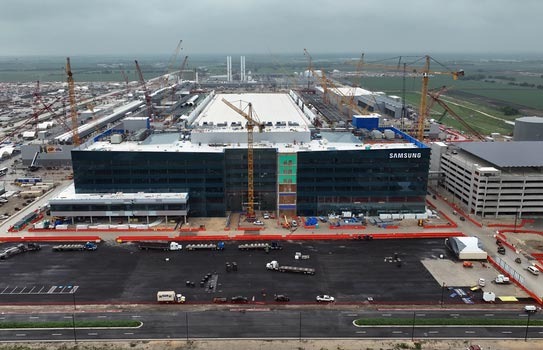
Recently, the Taylor area in Texas is regaining its vitality.
Just a few months ago, there was a prevailing sentiment that 'the Samsung semiconductor factory might eventually be halted,' leading to a stagnant atmosphere, but the situation has completely changed recently. Construction, which had once come to a standstill, has started to pick up speed again, with large equipment arriving on site and job postings being continuously announced.
Samsung Electronics began construction of a semiconductor factory in Taylor, Texas, in 2021. At that time, the U.S. government's semiconductor industry promotion policy and global supply chain instability drew significant attention to 'Samsung's investment in the U.S.' However, as the semiconductor market rapidly froze in 2024, the situation became complicated. With demand decreasing and a global economic downturn coinciding, Samsung officially announced the suspension of construction in September 2024.
However, there was an event that miraculously changed the atmosphere. It was the signing of a $16.5 billion AI semiconductor supply contract with Tesla. This contract breathed new life into Samsung.
As Tesla chose Samsung's 2-nanometer (nm) process for producing chips for autonomous driving and AI systems, the Taylor factory has once again emerged as a key strategic hub. The movement is so significant that it can be described not just as a 'resumption' but as a 'rebound.'
Since the end of August, Samsung has placed orders for advanced semiconductor equipment worth about $4 billion (5.5 trillion won), and is currently hiring engineers and technical staff in two rounds in September and November. Among the newly assigned personnel are key technical staff dispatched from the Korean headquarters, and a chief officer dedicated solely to managing the Taylor factory has also been appointed. This indicates a strong commitment to this project.
The production process being pursued this time is Samsung's second-generation 2nm technology, SF2P. Once the Taylor factory is fully operational, it is expected to produce about 16,000 to 17,000 12-inch wafers annually. The plan is to transition to mass production by the end of 2026 or early 2027, and Tesla's AI6 chips are also expected to be mass-produced here. Interestingly, Elon Musk is personally interested in the operation of this factory and is overseeing the site management.
In fact, when the Taylor project was first planned, the industry's expectations were very high. As Intel and TSMC expand their semiconductor factories in the U.S., Samsung was the only global company that could directly compete with them. However, due to the highly volatile semiconductor market cycle, Samsung was not exempt from challenges. Fortunately, with the Tesla contract, a new breakthrough has been found, and 'Samsung's Texas drama' has entered a phase of reversal once again.
Now, there is growing anticipation locally that the completion of the Taylor factory will create over 2,000 new jobs.
The Texas state government is also preparing to support the local industrial ecosystem by providing power, water supply, and transportation infrastructure. In the trend of restructuring the U.S. semiconductor market around Intel, TSMC, and Samsung, the Taylor factory is likely to become an important strategic hub.
There are still many challenges ahead. The execution of semiconductor subsidies in the U.S. is delayed, and global economic uncertainty remains. However, what is clear is that Samsung Electronics has turned the engine back on. The halted construction is resuming, new contracts are being signed, and talent is gathering again.
Ultimately, the story of the Taylor factory has become a symbol of how a Korean company overcomes crises within the flow of the global semiconductor industry, rather than just a simple construction project.








 xylora |
 Aura-Infused WACAM |
 wendra |
 There Are Such Things in the World |
 Atlanta Mama |
  Baguette Blog |
  US Embassy |
  Korean Mom |
  My NYC |
  moo moo |
  Mr Oh |
  forevergee |
  festival |
  manchester |
  constant |
  Leapfrog Move |
  vibranto |
  Tora Tora |
  yellowbutter |
  Dolly |
  NYC saladbar |
  Finding Superfoods |
  lightyear |
  song bang |