

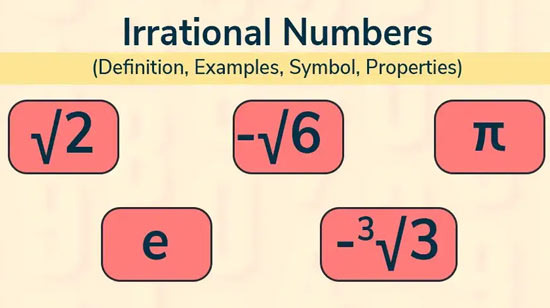
The term irrational may sound intimidating, but its meaning is simpler than you think. You can think of them as the "unmanageable ones" in the world of numbers.
The numbers we commonly use, like 1, 2, 3, 0.5, and 3.75, can all be accurately expressed as fractions. For example, 3.75 is 15/4, and 0.5 is 1/2. These are called rational numbers.
However, there are numbers that simply cannot be expressed as fractions, no matter how hard you try. These are numbers with endless decimal expansions that do not repeat. These are the irrational numbers.
A classic example is √2. The number 1.4142135623... has a decimal that goes on forever. More importantly, it does not repeat in any pattern. Therefore, it cannot be accurately expressed as any fraction. Just as we approximate π with 22/7, we can get close to √2 with a fraction like 99/70, but we can never get the "exact same value." This is the essence of irrational numbers.
The same goes for π. The number 3.1415926535... has been calculated by mathematicians to trillions of digits using supercomputers, but it also goes on forever without any repeating pattern. Thus, π is also an irrational number. Most square roots like √3, √5, and √7 are also irrational. However, √4 equals 2, so it is not irrational. √9 equals 3. In other words, only the square roots of perfect squares are rational, while almost all others are irrational.
The reason these numbers exist is due to the lengths and angles in the real world. When one side of a square is 1, the diagonal length is √2. That length cannot be expressed as a fraction. The value of π, which is the circumference divided by the diameter of a circle, also cannot be expressed as any fraction. As we try to measure the world accurately, irrational numbers emerge.
Mathematically, irrational numbers exist densely mixed with rational numbers on the number line. No matter how much we divide the space between 0 and 1, there are infinitely many irrational numbers in between. Rational numbers alone cannot fill the number line; we need to include irrational numbers to encompass all real numbers.
Irrational numbers cannot be expressed as fractions, and they are numbers with endless decimal expansions that do not repeat. Examples like √2 and π are the main representatives. The reason they seemed difficult in school is that the calculations can be tricky, but the concept itself can be understood simply as "unmanageable numbers."
The importance of irrational numbers in mathematics lies in their ability to accurately describe the real world. Most of the lengths, areas, angles, and curves we measure do not fit neatly into fractions. Values like the diagonal length of a square, √2, and the ratio of a circle's circumference, π, are essential for expressing nature and space, and all of these values are irrational.
If only rational numbers existed in mathematics, we would not be able to accurately represent actual space. Additionally, irrational numbers play a crucial role in completing the real number system. To fill every point on the number line, rational numbers alone are insufficient; we must include irrational numbers.
To be honest, not knowing the concept of irrational numbers does not significantly impact daily life. You can shop at the store, calculate rent, find directions, and handle work tasks without knowing the nature of √2 or π. Most people will rarely need to use irrational numbers directly in their lives.
However, without irrational numbers, technologies like smartphones, GPS, building designs, satellites, and medical devices would not exist. Even if we are unaware, irrational numbers are constantly at work behind the scenes in science and technology. You can live without knowing them, but their existence underpins modern society.







 Magic Cabbage School of Martial Arts |
 Vacation on Hawaii |
 morvex37 |
 Ari Songhan American Immigration Life |
 Bearded Strawberry Smoothie |
 US 210 Kim Sangsa |
 Mental Health Psychiatrist |
 Gupabal MissKorea |
 August Snowman |
 Atlanta Mama |
  Baguette Blog |
  US Embassy |
  Korean Mom |
  My NYC |
  moo moo |
  Mr Oh |
  forevergee |
  festival |
  manchester |
  constant |
  Leapfrog Move |
  vibranto |
  Tora Tora |
  yellowbutter |
  Dolly |
  NYC saladbar |
  Finding Superfoods |
  lightyear |
  song bang |