

Texas was geologically a shallow sea. Millions of years ago, this area was covered by seawater, and as corals, shells, and microorganisms died and accumulated, thick layers of limestone were formed. That is why if you dig just a little into the ground, you can find white limestone.
This limestone layer extends into the Edwards formation and the Austin chalk formation, spreading throughout Texas. Limestone dissolves well in water, creating caves and aquifers, and forming the unique karst topography of Texas. Therefore, there are many caves in Central Texas, and large aquifers have developed around San Antonio and Austin.
The reason for oil deposits is also closely related to this structure and depth. Organic matter accumulated in the shallow sea, and the limestone and shale layers that covered it transformed into oil and gas under heat and pressure. Later, due to the fault and fold structures of the layers, oil became trapped, forming massive oil fields across Texas today.
Names like the Permian Basin, Eagle Ford Shale, and Barnett Shale all result from this geological structure. The Texas oil region is so significant in terms of reserves and production that it is often referred to as the heart of the U.S. energy industry.
Among these, the Permian Basin is considered one of the largest oil fields in the world, accounting for a significant portion of the total U.S. crude oil production. The reserves are estimated in the tens of billions of barrels, and thanks to the layered structure of shale and limestone, there are still abundant resources available for development.
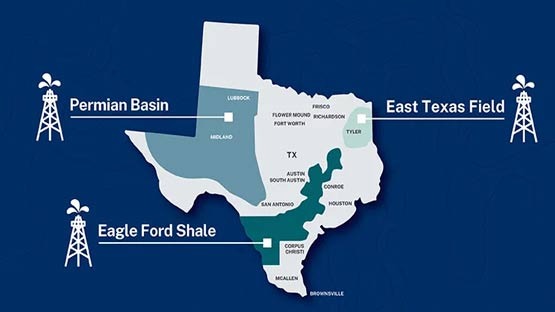
The geological area where I live, Dallas, is located at the junction of the plains in northern Texas and the Austin chalk formation.
Under Dallas, thick layers of limestone and shale are stacked, and beneath them lies a massive gas layer known as the Barnett Shale. This is why the Dallas and Fort Worth area has become one of the key regions in the U.S. shale gas industry. The reason why digging the ground often yields many rocks and makes the foundation work particularly difficult is also due to this limestone region.
Fossils are found all over Texas. In particular, marine fossils are very common in the limestone layers of Central and Northern Texas. Shells, ammonites, corals, and traces of marine reptiles are still discovered at construction sites. Dinosaur fossils are mainly found in Northern and Central Texas.
The Glen Rose and Paluxy River area is world-famous for its dinosaur footprint fossil site, and many large dinosaur fossils have also been found in the Big Bend National Park area.
Ultimately, I believe that the geology of Texas is the fundamental system that determines oil, limestone, fossils, and even the urban structure and industry of this region. Therefore, Texas is evaluated as a region that will not easily give up its status as an energy hub even after decades.
I hope that the romantic era of oil development in Texas, where oil would gush out just by buying land and digging, will repeat itself once again in our time.







 lightyear |
 Moscow Kim |
 coloradoman |
 Montgomery Mom |
 GOGO SING |
 xylora |
 Aura-Infused WACAM |
 wendra |
 There Are Such Things in the World |
 US Embassy |
  Korean Mom |
  My NYC |
  moo moo |
  Mr Oh |
  forevergee |
  festival |
  manchester |
  constant |
  Leapfrog Move |
  vibranto |
  Tora Tora |
  yellowbutter |
  Dolly |
  NYC saladbar |
  Finding Superfoods |
  song bang |
  vexomo |
  Indiana Jones |