

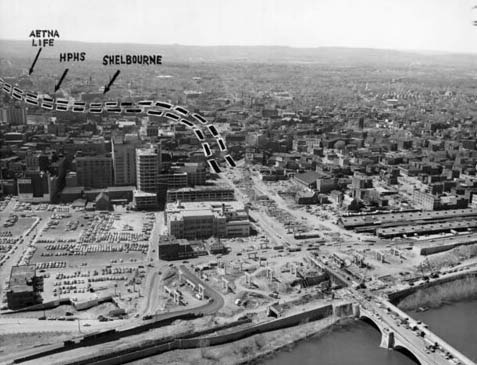
Hartford in the 1950s resembles what we know today, yet if you look closely at the air and atmosphere of that time, it feels like a natural flow of how a city thrived, stumbled, and found its way again.
During a time when the entire post-war America was accelerating its growth, Hartford was enjoying a golden age centered around the insurance industry. With more disposable income in paychecks, downtown was bustling with suited professionals, and people would stop in their tracks whenever new products appeared in the windows of large department stores. As cars became more common, families began moving to the suburbs, and areas like West Hartford started to establish themselves as stable middle-class neighborhoods. Husbands commuted to insurance companies while wives shopped at local markets, embodying a somewhat textbook version of the 'American Dream' that unfolded in this city.
However, beneath that prosperity lay signs of change. As manufacturing jobs moved to other cities and automobile traffic developed, many people began heading to new shopping centers in the suburbs instead of downtown. As a result, from the late 1950s, downtown began to show slow signs of decline, with department stores and small shops starting to close one by one. The economy remained solidly based on the insurance industry, but it was skewed without diversification.
Looking at the social background, changes also occurred in race and housing structures. The post-war baby boom increased the population, but the city center began to show signs of vacancy, and suburban expansion accelerated. The Black population in the city increased, while white families moved to the suburbs, naturally deepening racial segregation during that time. Reflecting on Hartford back then, I would say it was a city where glamour and imbalance coexisted. The economy grew, but the benefits of that growth were not evenly distributed, and disparities between regions began to widen.
Still, looking at photos and records from 1950s Hartford evokes a warmth different from today. When new movies premiered at downtown theaters, people lined up, and during the Christmas season, streets were adorned with colorful decorations that made children's eyes sparkle. Families enjoyed picnics in parks, and the laughter of children holding ice cream filled the air; the impending changes of the era were not yet keenly felt. The streets may be quiet now, but back then, they were likely filled with lively voices and the sounds of footsteps.
When I think of Hartford in the 1950s, the phrase 'the city shone its brightest' comes to mind. At the same time, it reminds me of the cracks that began to form behind that light. The risks of relying on a single industry, the process of suburban expansion emptying the city center, racial tensions, and social gaps—all of these contributed to shaping today's Hartford, and traces of that era still remain in the streets we walk today. The color of the bricks in old buildings, the signs of long-gone theaters, and the breath of the past felt when standing by the riverfront.
Sometimes, as I walk through this city, I imagine Hartford in the 1950s. The busy morning commute, the buzz of lunchtime restaurants, and in the evening, the jazz flowing from bars. And the quiet tension where innovation and change began. Though it was a period in history, that time still weighs heavily on the city's framework today.



 ultron78 |
 garlic bread |
 Sugar Cream Door Bulletproof Noodles |
 urbanmint |
 |
| 
 Buckwheat Muktudari Notebook |
 Jin Soo V |

 Korean Mom |
  My NYC |
  moo moo |
  Mr Oh |
  forevergee |
  festival |
  manchester |
  constant |
  Leapfrog Move |
  vibranto |
  Tora Tora |
  yellowbutter |
  Dolly |
  US Embassy |
  NYC saladbar |
  Finding Superfoods |
  lightyear |
  song bang |
  vexomo |
  Indiana Jones |