

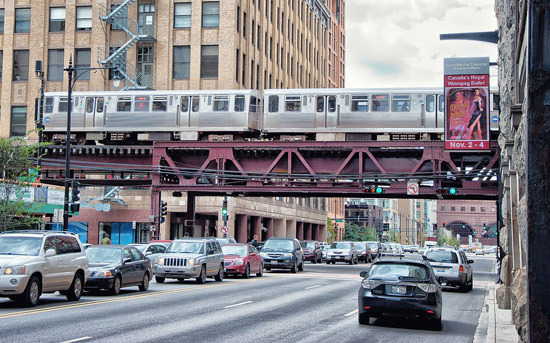
Walking through downtown Chicago, you are constantly accompanied by the rattling of the L train right above your head.
The "L" is short for "elevated," a nickname given because most of the line runs along high tracks above the city streets.
In other words, it refers to an elevated railway. Initially, Chicago's public transportation was mostly built as elevated, and that's why people started calling it El → L.
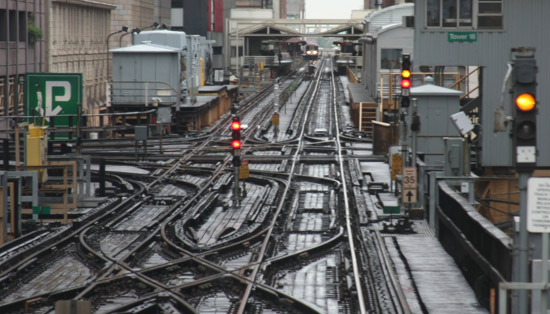
To tourists, it might look like a movie set, but for commuting Chicago residents, it's the reality of noise and vibrations that make you think, "Ah... here we go again." The rails, woven like a spider web above the city, connect the North Side to the South Side and even to the western suburbs, but the problem is that there are too many connections.
There are two stations named Addison, two named Washington, Lake, State... Just by the names, it seems like they are all close, but if you take the wrong direction, you can end up at the opposite end in an instant. It's the same station, but one side is underground while the adjacent line runs above, and the Orange line heads to the airport while the Blue line goes straight to O'Hare.
First-time visitors to Chicago experience a feeling of confusion as the map twists and turns in their minds, making them wonder, 'Is this a city or a maze?'
Once you enter the Loop section, it gets even more interesting. The rails wrap around the city center, making it look like the city is wearing a metal bracelet. It looks great in photos. But in reality? Trains pass right in front of buildings, creating a deafening metallic sound.
During a meeting in the office, when a train passes, the conversation stops, and during a Zoom meeting, you can't help but shout, "Sorry, the train is passing."
The platforms are a mix of first, second, and underground levels, making you question yourself three times, "Am I going the right way?"
You rush to catch a train only to realize it's going in the opposite direction, or that the train you need won't arrive for another ten minutes.
Many people get lost unless they are familiar with the station. For tourists, it's an urban adventure, but for locals, it's a source of stress.
The route map, which seems to kindly guide you with colors, is actually more like a color puzzle that mocks you. Red is straightforward, running north and south, making you think, "Okay, I got this," but Brown and Purple loop around and suddenly change direction, Green goes west then curves south, and Pink is known for its confusing routes. Just when you think, "If I go to the Loop, I'll be connected," you often witness trains that skip the Loop and go straight.
Despite this chaos, it keeps downtown Chicago lively. The rails shake, trains cut through the city, and when you sit in a café, a metal mass rushes by the window, giving you the sense that 'this is a real city.'
Many cities boast quiet and orderly transportation, but Chicago proves its identity with rough noise, vibrations, and speed. Even while cursing and getting lost, you find yourself returning, and at some point, the absence of that noise feels strangely empty.
Ultimately, Chicago's train lines resemble a tangled ball of yarn more than a neatly organized map. But within that tangle lies the charm of this city.
Imperfect yet alive, noisy yet captivating scenery. The frantic trains running through the Loop seem to be the heartbeat of Chicago.







 Illinois Mom |
 Rice Shop Uncle BLOG |
 Khan Film Blog Production |
 Nanana Nanana Nanana |
 Enjoyable American Life Diary |
  Korean Mom |
  My NYC |
  moo moo |
  Mr Oh |
  forevergee |
  festival |
  manchester |
  constant |
  Leapfrog Move |
  vibranto |
  Tora Tora |
  yellowbutter |
  Dolly |
  US Embassy |
  NYC saladbar |
  Finding Superfoods |
  lightyear |
  song bang |
  vexomo |
  Indiana Jones |