
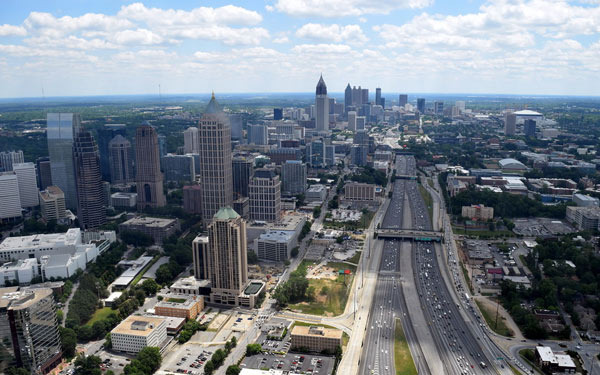
Georgia did not become a populous and economically strong state overnight.
For a long time, Georgia was primarily agricultural, and its industrial and population growth was relatively slow compared to other states.
However, there were several pivotal moments when this changed dramatically.
In the early 19th century, the cotton industry boomed, leading to significant growth in Georgia's agriculture.
The climate in the southern United States was ideal for cotton cultivation, allowing Georgia to rapidly accumulate wealth based on slave labor, and port cities like Savannah thrived as trade centers.
But everything fell apart after the Civil War. The plantation economy collapsed, and with the end of slavery, the existing production system was shattered, leaving Georgia one of the poorer states in the South.
From this point, Georgia began to seek "paths beyond agriculture," which became a true turning point for development. By the early 20th century, with the onset of the world wars, industrialization began to take hold, and Georgia started to shift its economic base by attracting military factories, railroads, and manufacturing.
However, the changes were still slow and retained a southern feel until the explosive growth of the 1960s to 1980s, particularly when Atlanta began to grow significantly. Atlanta's importance lies in its location.
It became a transportation hub connecting the East and South, attracting industries, logistics, broadcasting, and corporate headquarters, and today, Atlanta's airport is one of the largest in the United States.
This naturally led to an influx of businesses, population growth, and urban expansion, boosting Georgia's overall economy.
Moreover, since the 1990s, the hosting of the Olympics greatly improved infrastructure, and the entry of IT and media companies transformed its image from a "typical southern state" to a dynamic one.
Now, Georgia is recognized as one of the most vibrant states in the South, with a mix of agriculture, logistics, film industry, aviation, IT, and education.
The development of Georgia was not a sudden explosion; it was a case of building wealth through agriculture, collapsing due to war, and then rising again through industrialization and urban growth.
In particular, the city of Atlanta played a significant role as a major engine, helping Georgia transition from a "slow southern state" to a "future-oriented state."
Ultimately, Georgia's development story could be described as "the reboot of the South after experiencing decline."







 moonshine 7 |
 Dingho and USA News |
 Korea Tiger News |
 Let's Be Like a Salt-like City Person |
 Tonky |
  viroma |
  cookie |
  Live and that's it |
  Alright Twain |
  eatontown blog |
  HAWAII Korean Church News |
  Amore |
  linex |
  Balancework |
  laro90 |
  MEDBIO American Doctor Blog |
  SWAT TEAM BLK |
  DREAM BIG |
  frostbite |
  330 Forever My Love |
  El Dorado |
  dralix58 |
  Gorama Round |
  Skydiving |