
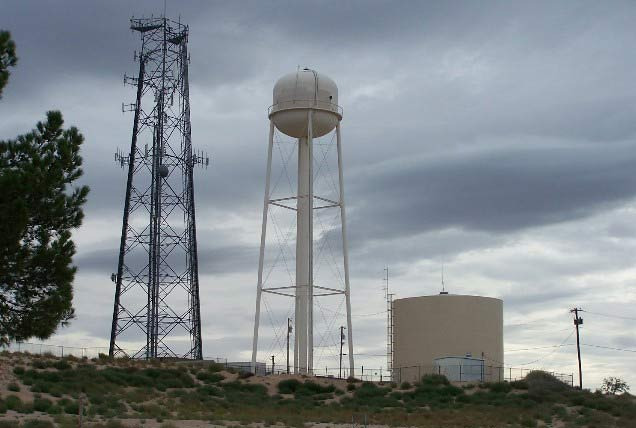
As you travel around the San Antonio area, you can easily spot huge water tanks standing tall in every neighborhood, even in the middle of empty plains. These white cylindrical metal structures often have the city name written in large letters or feature the school mascot.
At first glance, you might wonder, "Why is there such a large water tank next to a house or road?" However, this is actually a reflection of Texas's water supply methods, geography, and climate characteristics.
Texas is one of the hotter regions in the United States. There are many days in summer when temperatures approach 40 degrees Celsius, and dry areas receive little rainfall. In such climates, having a reliable system for storing water is crucial. This is why tall water tanks are built in every city. Generally, these structures are called water towers and serve not just as simple storage facilities but as devices that supply water pressure to the entire city.
The principle is surprisingly simple. By placing the water tank high up, gravity allows the water to flow down naturally, creating high pressure. This is why most homes and commercial facilities can use tap water without high pumps.
If the tank is on the ground, there is no pressure, and water does not flow, but raising it just 30 to 50 meters creates significant pressure, maintaining enough water pressure for daily use. Since it does not rely solely on electric pumps, there is also the advantage of maintaining supply for a certain period during power outages.
Another reason is emergency preparedness. Texas frequently experiences natural disasters such as heatwaves, cold snaps, droughts, and hurricanes. If water pipes burst during a winter cold snap, the water supply is cut off, and during summer droughts, usage spikes. To withstand such situations, water must be stored in advance, and water towers serve that purpose. They are filled with water from the urban water supply and release it as needed to maintain balance.
Regional characteristics also play a role. Texas has vast land, and the distances between cities are great. Therefore, many areas operate with their own water sources. Relying solely on large underground piping increases maintenance costs and the impact of accidents. However, having water tanks in each town allows for efficient management at the local level. Many places are connected to aquifers or groundwater pumping, and some operate with a circulation system that directly connects to purification facilities to fill and drain water.
When traveling in Texas, it's also interesting to see the different colors and designs of the towers. Some places simply have the city name written, while others feature large images of cowboys, longhorns, or high school football team logos. They serve as a kind of landmark, embodying local pride. In rural areas, you can easily tell where a town is just by spotting the water tank from a distance. There's even a saying that you can head straight toward that water tank without needing GPS.
In summary, the tall water tanks throughout Texas are infrastructure built to maintain water pressure, provide emergency storage, and create independent supply systems for different regions. In a hot and drought-prone climate, water is essential for survival, so it is prominently managed and placed high in the sky.
To tourists, they may seem like simple tanks, but they are actually one of the key infrastructures that keep Texas cities running.







 Helpful Life Stories |
 American Man in a Mask |
 Hajiwon Blog Hair Salon |
 Make My Day |
 TEXAS Fishing Boat |
  US Embassy |
  Korean Mom |
  My NYC |
  moo moo |
  Mr Oh |
  forevergee |
  festival |
  manchester |
  constant |
  Leapfrog Move |
  vibranto |
  Tora Tora |
  yellowbutter |
  Dolly |
  NYC saladbar |
  Finding Superfoods |
  lightyear |
  song bang |
  vexomo |
  Indiana Jones |