


Many famous founders in the United States often have surprisingly anticlimactic endings.
Some have built large companies but end up with relatively little personal wealth, while others cash out early before going public, receiving the assessment that "personal assets are relatively small compared to the company's reputation."
In that regard, Reed Hastings, the founder of NETFLIX, is quite a unique entrepreneur.
He destroyed the blockbuster business and created Netflix, a global streaming service, taking it public and maintaining significant ownership that translated into personal wealth as the company's value increased.
He co-founded Netflix in 1997, and in 2002, Netflix went public at $15 per share. After stepping down as CEO in 2023, he remained as chairman and plans to leave the board after the annual shareholders' meeting in 2026.
Forbes estimates his net worth at about $5.8 billion as of 2026, which is an astonishing amount close to 9 trillion Korean won.
It is said that he has donated around 1 trillion won so far.
The most important characteristic of Reed Hastings' wealth accumulation is that he is not just a "one-hit wonder" entrepreneur but rather one who has leveraged the compounding effects of a public company over a long period.
Many people associate an entrepreneur's wealth with a single M&A event, but Reed Hastings took a path much closer to the American capital market.
He took the company public and endured a long period during which the market re-evaluated the company as a larger entity.
Netflix started as a DVD rental service but transitioned to streaming, then expanded into original content, and has now established itself as a global entertainment platform.
The key point is that Reed Hastings has been part of nearly every stage of this long transition.
In short, the company underwent multiple transformations, and he remained at the center each time rather than being pushed out completely.
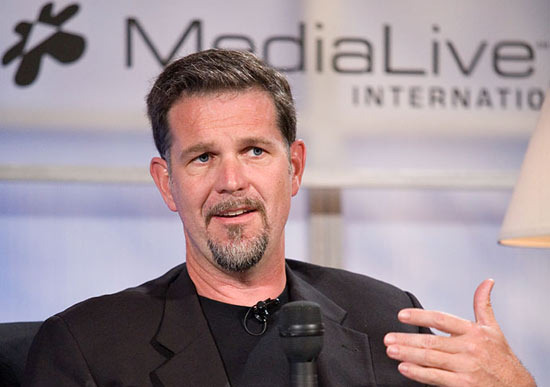
Another noteworthy aspect is the ownership structure.
According to Netflix's 2026 data, Reed Hastings still held a significant stake, including 21,159,576 shares owned by the Hastings-Quillin Family Trust and an additional 16,595,546 options.
The most challenging aspect of wealth accumulation for founders is keeping a portion of the company's growth for themselves, and Reed Hastings excelled in that regard.
This type of entrepreneur may appear less glamorous on the surface. He doesn't have the style of Elon Musk, who makes headlines daily, nor is he the type like Jeff Bezos, whose massive ownership is particularly emphasized.
Thus, it is more accurate to view Reed Hastings' wealth as the result of accumulated market evaluations over more than 20 years of Netflix's growth rather than simply "money made from a single success in the early days."
In fact, Netflix could have collapsed in the middle.
If it had settled into the DVD business, it might have ended up as just another version of Blockbuster, and if it had missed the timing for the streaming transition, it wouldn't be in its current position.
However, Reed Hastings chose to disrupt his own business model. This is not as easy as it sounds.
Founders tend to cling to the formula that made them successful, but he did not hold onto the success of DVD rentals; he pushed for streaming and then moved on to larger bets in content investment.
As a result, these decisions boosted Netflix's market capitalization, and that increase in market cap led to his wealth growth.
Ultimately, his wealth comes not just from "holding stocks for a long time" but from continuously creating a company worth holding onto for a long time.
The reason I find this story interesting is that the true creators of significant wealth in the American capital market are not necessarily the ones who are most famous and exposed in the media.
Rather, it is those who maintain the power of their shares for a long time after taking their company public who ultimately reap the rewards. Reed Hastings is a prime example of this.
These days, the backlash against Baek Jong-won, the CEO of a recently listed company in Korea, oddly contrasts with Reed Hastings.
Baek Jong-won faces constant criticism as he expands his franchise, dealing with real issues like price, quality, and franchisee structure.
As the scale grows, reactions of "it's different from the initial image" follow. In contrast, Reed Hastings does not operate in a structure that directly confronts consumers.
Even if Netflix raises its prices, it faces criticism, but the attacks directed at him personally are relatively few. Instead, he has focused on increasing corporate value and reaped the results in stock.
As of 2026, he is almost stepping back from Netflix's management, but he has already become a textbook success story from the perspective of founder wealth.
He created a company, took it public, adapted the business to changing trends, and maintained his economic position throughout the process.
Therefore, it is not an exaggeration to say that Reed Hastings is not just the founder of Netflix but one of the founders who has most stably and significantly increased his wealth after going public.







 Swift Falcon |
 Tonky |
 My NYC |
 coloradoman |
 Living Economy Information Blog |
 Peter Pan Pet |
 Moscow Kim |
 Nuchuhan Exploration BLOG |

 Helpful Life Stories |
  Kitchen Ideas |
  Diana Blues |
  Agenda Center |
  Community Cross |
  journey |
  heeve |
  leman |
  corner kick |
  treasure |
  strawberry |
  Augusta Univ |
  B.I.G. Victor |
  Victory 1988 |
  venture |
  SPAM 101 |
  choi family |
  zoryan |