

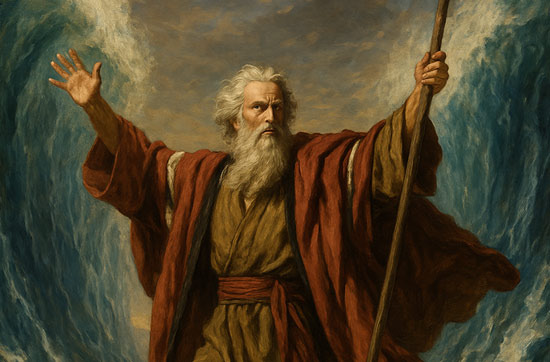
Moses is recognized as one of the most influential religious figures in human history, acknowledged as a significant figure in Judaism, Christianity, and Islam. These three religions share a common historical root as Abrahamic religions, which is why Moses holds an important position in each of them.
Moses in Judaism
-
In Judaism, Moses is regarded as the greatest prophet and the deliverer of the law.
-
He was the leader of the Exodus, liberating the Israelite people from Egypt, and received the Torah (law) directly from God on Mount Sinai.
-
The Torah (the Five Books of Moses, Genesis to Deuteronomy), the most important scripture in Judaism, is traditionally believed to have been written by Moses, and his teachings form the foundation of Jewish law and faith.
-
Jews still refer to Moses as "the teacher of the law" and use the law given through him as a guide for their lives.
Moses in Christianity
-
Christianity also recognizes Moses as a great servant of God.
-
He is depicted as a very important figure in the Old Testament, a prophet who conveyed God's revelations and laws (including the Ten Commandments).
-
However, Christianity emphasizes grace and salvation through Jesus Christ more than the law itself.
-
In the New Testament, Jesus is sometimes likened to a new Moses, and just as Moses saved Israel in the Old Testament, Jesus is seen as having saved all of humanity.
-
Thus, Moses holds significant theological meaning as a figure that foreshadows Jesus' ministry.
Moses in Islam
-
In Islam, Moses is referred to as Musa and is recognized as one of the most important prophets.
-
He is frequently mentioned in the Quran as one of the 25 major prophets, even more so than Jesus (Isa), highlighting his importance.
-
The Quran details the story of Moses receiving God's revelations and rescuing the Israelites from Egypt.
-
Islam acknowledges him as the recipient of God's law (the Tawrat, or Torah), but believes that the final revelation was given through Muhammad.
-
Islam considers Moses a true Muslim (one who submits to God) and highly values his faith, patience, and leadership.
Moses' life can be divided into three major periods, each lasting about 40 years.
40 Years in the Egyptian Palace
Moses was born as a Hebrew in Egypt. At that time, the Pharaoh feared the rapidly increasing number of Hebrews and ordered that all male infants be thrown into the Nile River. However, Moses' mother, Jochebed, hid him until she could no longer do so, and placed him in a basket made of reeds, setting it afloat on the Nile. The Pharaoh's daughter discovered the basket, took pity on the baby, and adopted him, naming him Moses. The name Moses means 'to draw out of the water.'
Moses grew up in the Egyptian palace like a prince, receiving the best education and culture, but he did not forget his identity as a Hebrew. One day, witnessing an Egyptian abusing a Hebrew, he became enraged and killed the Egyptian, burying him in the sand. When this incident became known, Moses felt threatened and fled to the land of Midian.
40 Years in the Midian Wilderness
In Midian, Moses married Zipporah, the daughter of the priest Jethro, and lived a simple life as a shepherd. During this time, he learned humility and patience, preparing to understand God's will. One day, he heard God's voice from a burning bush that was not consumed by the fire on Mount Horeb. God commanded Moses to return to Egypt and liberate the Hebrew people. Initially hesitant due to his perceived shortcomings, Moses ultimately obeyed God's persuasion and promises and returned to Egypt.
40 Years Leading the Israelites
Upon returning to Egypt, Moses, along with his brother Aaron, approached Pharaoh to deliver God's command to "let my people go." However, Pharaoh stubbornly refused, prompting God to send ten plagues upon Egypt. After the final plague, the death of the firstborn, Pharaoh finally released the Israelites.
After the Exodus, the Israelites reached the Red Sea, but Pharaoh changed his mind and sent his army to pursue them. At this moment, Moses, following God's command, raised his staff and parted the Red Sea. The sea split, allowing the Israelites to cross on dry ground, while the pursuing Egyptian army was drowned in the water.



 SEVEN SEVEN |
 Korean Mom |
 novapixel |
 Peter Pan Pet |
 horse |
 maplefox |
 Potato House |
 mygoddess blog |
 puffpanda |
 SanAntonioNews |
  citrus pop |
  Onion Ring |
  phoenixia |
  viewtop |
  loverun |
  Kim Do Sun |
  yentra |
  Make My Day |
  Victory 1988 |
  Tonky |
  viroma |
  cookie |
  Live and that's it |
  Alright Twain |
  eatontown blog |
  HAWAII Korean Church News |
  Amore |
  linex |
  Balancework |