
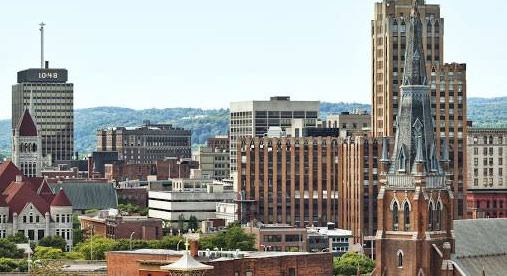
Early History
- The Syracuse area was originally inhabited by the Oneida Nation, Native Americans who were part of the Iroquois Confederacy.
- In the 17th century, European settlers arrived and discovered natural salt springs in the area, which led to its nickname "Salt City."
19th Century: Industry and Development
- In 1825, the completion of the Erie Canal transformed Syracuse into a major trade and transportation hub in central New York.
- Salt production became a key industry until the mid-19th century, after which manufacturing and railroads played significant roles in the city.
20th Century: Economic Changes
- In the early 20th century, Syracuse became a center for manufacturing in automotive parts, steel, and furniture.
- However, by the late 20th century, changes in the industrial structure led to a decline in manufacturing and economic challenges.
Modern Era
- Today, Syracuse has established itself as a college town, centered around education and healthcare, particularly Syracuse University.
- The local economy is based on technology, energy, healthcare, and educational services.
Demographics (Estimated 2025)
- Total Population: Approximately 145,000
- Racial Composition:
- White: Approximately 55%
- Black or African American: Approximately 30%
- Hispanic/Latino: Approximately 10%
- Other: Approximately 5% (Asian, Native American, etc.)
- Age Distribution:
- Children (0-18 years): Approximately 22%
- Young and Middle-aged Adults (18-64 years): Approximately 65%
- Seniors (65 years and older): Approximately 13%
Economy and Median Income
- Median Household Income: Approximately $43,000
- This is lower than the overall median income for New York State (approximately $75,000).
- Key Economic Sectors:
- Education: Syracuse University is the center of the local economy.
- Healthcare: Institutions like Upstate Medical University are significant employers.
- Services: Small businesses and tourism.
- Poverty Rate: Approximately 30%, which is higher than the national average.
Key Points
- Syracuse initially grew around the salt industry, but now education and healthcare drive the economy.
- The city is characterized by a diverse racial composition and a college-centered culture.
- Economic challenges still exist, but there is a transition to a new economy focused on technology and energy.








 healthy |
 Moo Tang Clan |
 Static |
 Belgray Miscellany |
 newyorker 101 |
  Korean Mom |
  My NYC |
  moo moo |
  Mr Oh |
  forevergee |
  festival |
  manchester |
  constant |
  Leapfrog Move |
  vibranto |
  Tora Tora |
  yellowbutter |
  Dolly |
  US Embassy |
  NYC saladbar |
  Finding Superfoods |
  lightyear |
  song bang |
  vexomo |
  Indiana Jones |