
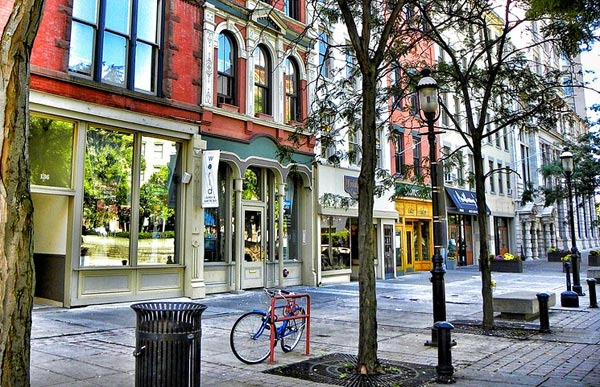
Syracuse was once a prosperous city that served as an industrial hub in central New York.
Even in the early 20th century, it was known as a center for industry, education, and transportation, along with Syracuse University, making it a vibrant college town. However, many say that today's Syracuse is far from the glory of those times. The city is gradually aging, and the young population is leaving. Therefore, I believe it is truly a time for change.
The biggest problem is the stagnation of the economic structure. Syracuse was once a city centered on traditional manufacturing industries like automotive parts, steel, and paper. However, with globalization and automation, these industries have gradually declined, and there has been a lack of new large corporations or high-tech industries. Since the 1990s, jobs have continued to decrease, and even now, the median household income is significantly lower than the national average. The city used to rely solely on manufacturing, but now it cannot fill the void left by the disappearance of that industry. If this structure is not changed, Syracuse will remain a "quiet but lifeless city."
The second issue is population decline and aging. Most young people leave for major cities like New York City, Boston, or Chicago after graduating from college. This is due to a lack of jobs and limited cultural diversity or career opportunities. Syracuse's population exceeded 220,000 in the 1950s, but now it has dropped to around 140,000. This is not just a simple decrease in numbers; it is a sign that the city's vitality is diminishing. The number of vacant homes is increasing, the tax base is weakening, and a vicious cycle of economic contraction is continuing.
The third issue is the aging of urban infrastructure. Many roads, housing, and water and sewage facilities were built in the 1960s and 70s. Maintenance costs are increasing, and there is hardly any new construction. The elevated highway I-81, located in the heart of the city, symbolizes this. This road was once seen as a symbol of development that crossed the city, but now it has become a symbol of aging and regional disconnection. Plans for redevelopment to remove this elevated highway and reconnect the downtown area are underway, but there is still much debate for and against it. However, the very fact that such discussions are happening is evidence that Syracuse recognizes the need for change.
That said, there is still hope. In fact, Syracuse is a city with the potential to leap forward with new industries. In recent years, Micron announced plans to build a $100 billion semiconductor factory in Clay, near Syracuse. This single project is expected to create thousands of jobs and attract related small businesses. If this plan proceeds properly, Syracuse could once again rise as a center of manufacturing and technology. However, to connect such large-scale investments to local growth, securing skilled labor and expanding transportation and housing infrastructure is essential. It is not just a matter of "a factory coming in."
Additionally, more collaboration between Syracuse University and the local community is needed. This city is home to a prestigious university, but often the university and the community operate separately. There are almost no reasons for students to stay in the area after graduation. If the university actively operates technology startup incubators or local entrepreneurship programs, young talents may take root in Syracuse. For example, fields like green energy or climate tech are industries that New York State is focusing on, so Syracuse could become a center of these changes.
The change in Syracuse ultimately means being reborn as a city that attracts people back. It cannot be solved simply by building a few factories. The city must be created as a place where jobs, culture, housing, and transportation come together. Given the long winters and heavy snowfall, it is also important to increase indoor cultural facilities and community spaces. Real change begins when the younger generation feels, "I want to live here."
In the end, Syracuse is a city that cannot avoid change. For a long time, it has been satisfied with "just getting by" amid industrial decline and population loss, but now it must go beyond that limit. When Micron's investment, university innovation, and citizen participation come together, Syracuse can be reborn as a 'living city.'
Now is the turning point. I look forward to the day when this city will once again be called 'the center of a new New York.'








 healthy |
 Moo Tang Clan |
 Static |
 Tennis City |
 namico |
  Tonky |
  viroma |
  cookie |
  Live and that's it |
  Alright Twain |
  eatontown blog |
  HAWAII Korean Church News |
  Amore |
  linex |
  Balancework |
  laro90 |
  MEDBIO American Doctor Blog |
  SWAT TEAM BLK |
  DREAM BIG |
  frostbite |
  330 Forever My Love |
  El Dorado |
  dralix58 |
  Gorama Round |
  Skydiving |