
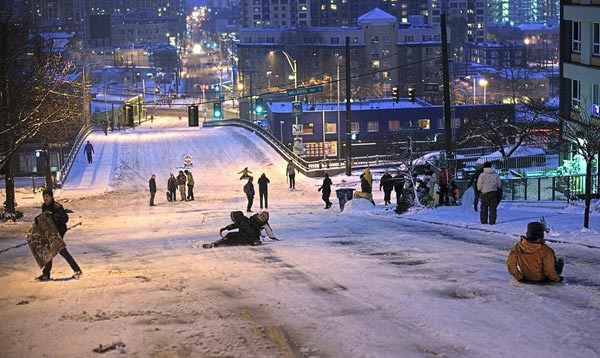
There have been a few instances of heavy snowfall in Seattle, sometimes referred to as 'snow bombs'.
The rare snowfalls that accumulate in Seattle, where snow typically does not pile up, are intense enough to paralyze the entire city and remain in people's memories. The official record for the most snow to fall in Seattle was set on February 2, 1916, over 100 years ago. On that day, a staggering 21.5 inches, about 55 centimeters, of snow fell.
As a city that usually does not receive much snow, the residents were truly shocked, and the streets were quickly covered in snowdrifts. Streetcars came to a halt, buses were stuck on the roads all day, and there were incidents of roofs collapsing. Photos from that time show snow piled up to the height of people's heads in front of homes, indicating the extraordinary snowfall.
This snow bomb did not just fall in one day; it was compounded by additional snowfall on top of already accumulated snow, leading to even greater damage. The city's functions nearly came to a standstill, and people found it difficult to go out for several days. Although there have been a few significant snowfalls in Seattle since then, none have been as record-breaking as in 1916. However, a similar event is often mentioned from the winter of 1950. In January of that year, nearly 50 centimeters of snow fell, completely paralyzing the roads. Residents referred to that time as 'Seattle's snow disaster'.
The rarity of such heavy snowfalls is due to Seattle's climate. With a maritime climate, it remains relatively warm even in winter, and when it does snow, it quickly melts or turns to rain. The warm air blowing in from the Pacific helps maintain the city's overall temperature, resulting in fewer days below freezing and making it difficult for snow to accumulate. Therefore, Seattle averages only about 4 to 5 days of snowfall per year. Even when it does snow, it usually disappears within a few hours and does not remain on the roads.
However, because of this, when heavy snow does fall in Seattle, the city can easily become paralyzed. In areas where snow is common, snow removal equipment is well-equipped, but Seattle is not accustomed to snow, leading to a lack of equipment and road designs that do not consider snowy conditions. With many hills, it is common to see buses and cars sliding down slippery roads.
The year with the most snowfall in a single season in Seattle was the winter of 1968-69, when approximately 170 centimeters of snow fell. It was a truly exceptional year when the entire city was blanketed in white. Since then, there have been very few similar heavy snowfalls.
Recently, due to climate change, there have been one or two years with slightly more snow, but snow remains a 'special guest'. In 2021, nearly 20 inches of snow accumulated, causing traffic disruptions for several days, but residents welcomed it with joy.
Ultimately, snow in Seattle is not an everyday occurrence but an event. It can come or it may not, always an unpredictable play of nature. So when it snows, the entire city slows down, but the romance of it increases.





 Bald Eagle Brothers |
 Bacon King Blog |
 PETRO Vatican Shrine |
 Seattle - Emerald City |
 Real Estate Agent USA |
  Tonky |
  viroma |
  cookie |
  Live and that's it |
  Alright Twain |
  eatontown blog |
  HAWAII Korean Church News |
  Amore |
  linex |
  Balancework |
  laro90 |
  MEDBIO American Doctor Blog |
  SWAT TEAM BLK |
  DREAM BIG |
  frostbite |
  330 Forever My Love |
  El Dorado |
  dralix58 |
  Gorama Round |
  Skydiving |