


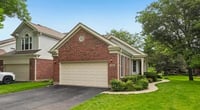
Arlington Heights is a market that is difficult to assess based solely on numbers due to its school district premium. The median rent is around $2,350 per month, while the median home price is approximately $415,000.
Calculating the Price-to-Rent Ratio, dividing $415,000 by the annual rent of $28,200 gives a ratio of 14.7. This falls below 15, indicating that buying is more favorable. It is noteworthy that this ratio is relatively low for a region known for its strong school district reputation among the northwest suburbs of Chicago.
Let's calculate the monthly payment. Excluding a 20% down payment of $83,000, borrowing $332,000 at a fixed rate of 6.75% for 30 years results in a principal and interest payment of $2,153. However, Illinois has one of the highest property tax rates in the nation. Factoring in the local tax rate, the monthly property tax adds $674, bringing the total PITI to $2,949. This means you would be paying an additional $599 per month compared to renting.
The opportunity cost of investing the $83,000 down payment cannot be ignored. Assuming a 7% return, this amounts to $5,810 annually, or $484 monthly. Combining the burden of property taxes and opportunity cost increases the effective cost of buying. This clearly indicates that property taxes are the biggest variable in purchasing in Arlington Heights.
Nonetheless, the steady interest from Korean families looking at the school district is clear. Compared to nearby Glenview or Northbrook, Arlington Heights still offers a lower entry price while maintaining a comparable school district quality.
If the residency period is less than 5 years, the high property tax burden may make renting a safer option. Conversely, if children need to fully experience the K-12 school system, meaning a commitment of 7 to 10 years or more is certain, buying may be the better choice. This is because property taxes are an annual expense, but the school district premium tends to hold its value upon resale.
From the perspective of Korean families, it is advisable to check property tax relief programs (such as the Homestead Exemption) and recalculate the actual payment amounts. In conclusion, for long-term residency aimed at school district benefits, buying is statistically the more rational choice, while renting is more reasonable for short-term stays.
 CupOfCola
 SpringRay






 |
| 
 Premium Gas Camp |
 CA Real Estate |
 cheesepup |
 breezem |
 greenlight |
 Arlington house |
 American General Knowledge Expert |
 valtri |
  August Snowman |
  Way to easy |
  Pirate Ship Popcorn Maker |
  USA Business News |
  Samsung My My |
  bubblo |
  tartbear |
  Washington Monument |
  Forever Young |
  crystalx |
  Spaghetti Flying Religion |
  lunarpath |
  Another Eden Channel BLOG |
  sprinkletop |
  bongo |
  savannah choi |
  Successful Manager Kim's Team |
  crystalo |
  Canvas Pro Blog |