

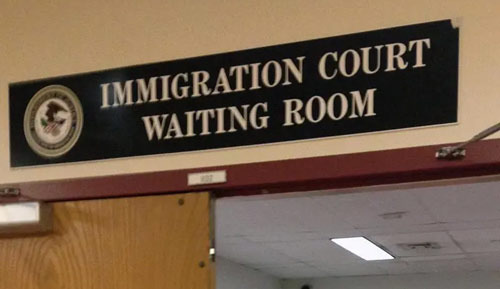
Recently, a federal judge in the U.S. ruled to "stop the practice of arresting individuals in or around immigration courts."
Immigration courts are places where individuals go to resolve issues related to their immigration status.
Whether it's a visa issue, deportation hearing, or adjustment of status, individuals must present their case before a judge.
However, in recent years, there have been increasing instances in some areas where individuals attending immigration court have been arrested by ICE agents.
To put it simply, it's like being called to the principal's office, only to find police waiting for you as soon as you step out the door.
This has led to concerns among individuals.
"If I go to court, I might get arrested, so maybe it's better not to go at all?"
In fact, this concern has been voiced among attorneys as well.
The judge pointed out this very issue.
If people avoid attending court out of fear of arrest, the immigration court system itself cannot function properly.
Another important point is that the judge noted, "The government has not provided sufficient explanation for why it is implementing such policies."
The U.S. is not a country where the president can create policies at will.
To change policies, reasons must be provided, and legal grounds must be established.
This ruling highlights the failure to adhere to such procedures rather than the content of the policy itself.
So, what impact will this have on Koreans?
For those in the process of applying for family-sponsored green cards, undergoing deportation hearings, or working on status restoration, this could be quite welcome news.At least, the situation where attending court leads to the risk of arrest has been curtailed by this ruling.
There are more individuals in the Korean community than one might think who are in such situations.
Some came as students and encountered status issues, while others faced complications with visa extensions or went through court procedures during marriage immigration or family sponsorship.
As a result, immigration law offices are closely monitoring this ruling.
Of course, this is not the end of the matter.
The federal government may appeal, and higher courts may issue different rulings.
The U.S. is a country where immigration policies can vary significantly depending on the administration.
However, what this ruling clearly shows is that no matter how strong the government's immigration enforcement policies are, legal procedures must be followed.
Living in the U.S., one sometimes thinks about how complex this country can be.
On one side, there are calls to strengthen enforcement against illegal immigration, while on the other side, there are arguments for upholding procedures and rights. And in between, the courts try to maintain balance.
This ruling can be seen as a part of that American system.
For most Koreans, this news may not bring about immediate significant changes.
However, it is certainly news worth paying attention to as it signals the potential direction of U.S. immigration policy in the future.
 PopcornDance
 PopcornLeap






 Sugar Cream Door Bulletproof Noodles |
 Investment Campus Home Ownership |
 U.S. Retirement Pension Information |
 California Dreamer |

 Victory 1988 |

 Lightning Sikhye Cooking Method |
  charger |
  holy cheese |
  Pleasant K |
  Rolling Joy Life |
  lidus |
  French Macarons |
  Central Intelligence Agency Deputy Director |
  ATL Power 1 |
  MP Forever |
  Soy Angelino |
  San Jose Pop |
  Pronunciation Yo |
  hamooo |
  Entip |
  Yavrix 92 |
  cherry cherry |
  Coastal city |
  There Are Such Things in the World |
  Mazinger Z Rocket Punch |
  celtics |