

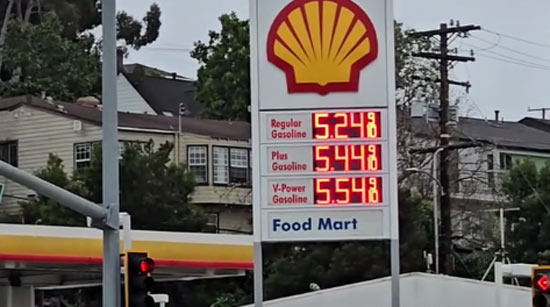
Living in LA, it's hard not to notice that this area has some of the highest gas prices in the U.S., yet people continue to fill up their tanks.
However, these days, every time I pump gas, I feel frustrated and let out a sigh.
When the price at the gas station goes over $5.40 per gallon, it shakes my mental state. But what's shocking is that the U.S. is the world's number one oil producer.
What kind of ridiculous situation is this? In 2023, the U.S. oil production is about 12.9 million barrels per day.
Saudi Arabia (about 9.7 million barrels) and Russia (about 11 million barrels) produce less than the U.S.
So why are gas prices in California like this?
Upon closer inspection, it turns out that oil prices are determined by the global market.
In the U.S., about 50-55% of gas station prices are due to oil prices. The rest is made up of refining costs, distribution costs, and taxes.
These oil prices are determined in real-time on the New York Mercantile Exchange (NYMEX) and the London Brent Oil market.
How much the U.S. produces is just one of many variables.
If OPEC+ decides to cut production or if geopolitical tensions rise in the Middle East, global oil prices spike.
The U.S. follows those prices regardless of its own production levels. In the end, it seems like only the oil companies are profiting from this situation.
For example, the Strait of Hormuz. About 20% of the world's oil supply, or about 17 million barrels per day, passes through this narrow strait.
The moment Iran threatens to block this strait, global oil futures prices react immediately.
No matter how much U.S. shale oil is produced, it cannot immediately offset global supply concerns.
Additionally, the U.S. both exports and imports oil.
In 2023, the U.S. imported about 3.8 million barrels per day.
Why? The oil primarily produced in the U.S. is high-quality light sweet crude, which is light and low in sulfur.
However, many of the refineries in the U.S. were designed decades ago to process heavy sour crude from the Middle East or Mexico.
Replacing this equipment is a multi-billion dollar project.
So, light crude is sold overseas, and heavy crude is imported from Canada or Mexico. This structure ties U.S. oil prices to the global market.
In California, the next biggest factor affecting prices is refining costs.
After the Russia-Ukraine war in 2022, Europe cut off Russian refined products, causing global refining margins to skyrocket.
From the perspective of oil companies, they made record profits, and consumers bore those costs.
This is one reason why gas prices at the pump haven't decreased even when oil prices stabilized.
And then there are taxes. California imposes the highest gas taxes in the U.S.
As of 2024, the state excise tax is about 68 cents per gallon, plus a federal tax of 18.4 cents, making the total tax nearly $0.87.
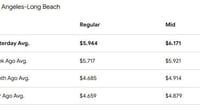
A significant part of why gas prices in LA are $1 to $1.5 more per gallon than in Texas comes from this. Texas's gas tax is around 20 cents per gallon.
We shouldn't view the issue of gas prices as just a gas station problem. Jet fuel prices are linked to jet fuel costs, and jet fuel is refined from crude oil.
If oil prices rise by 10%, airline fuel costs skyrocket, and that gets reflected in ticket prices.
The same goes for logistics. If trucking costs rise, everything on supermarket shelves becomes more expensive.
If the energy sector shakes in the price index, it causes a domino effect on food, transportation, and housing.
This is the structure of the inflation we experienced in 2022.
So the question, "Doesn't gas become cheaper if the U.S. produces more oil?" is incorrect.
Oil has always been a global single market. OPEC designed it that way, and the futures market completed it.
Even if the U.S. president releases strategic reserves, it only has a temporary effect. The structure is set up that way.
If we truly want energy independence, we need to transition refining infrastructure, modernize the power grid, and electrify transportation methods as a package deal.
Until then, when there are gunshots in the Middle East, the price signs at LA gas stations will change. This is the reality, so we just have to endure it.
In the end, consumers are the ones who suffer.





 Strawberry Pancake Warrior |
 My Town My Way Blog |
 celion78 |
 Only Dentalbay |
 Snack-like Blog Writing |
 Anjollinya Blog |
 California Dreamer |
 Beauty, Health, Lifestyle Blog |
 Good Karma |
 Study Abroad Life Know-How Tips |
  Hawaiian Dooly Mom |
  Roman Pan |
  Key spots |
  Community Cross |
  Oz's Wow Company |
  Wenda |
  Nuchuhan Exploration BLOG |
  Who's watching? |
  What can make money? |
  Egg Steamed Pot |
  New Jersey News Local Stories |
  My Love DS |
  Leapfrog Move |
  US Regional Information Local News |
  Finding Superfoods |
  COLO COLO |