

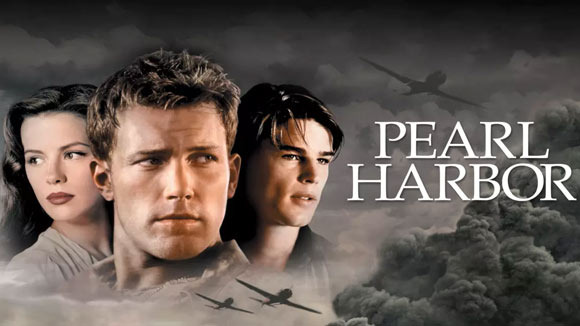
In the summer of 2001, the film that shook the box office was Pearl Harbor.
Honestly, this movie feels like Michael Bay was given free rein to create whatever he wanted, so when you come out of it, the feeling is a bit strange.
I'm confused about whether I just watched a serious world war movie, a romance, or a three-hour music video.
Perhaps this is the essence of the film.
Who is Michael Bay? When you watch his movies, historical accuracy? That doesn't seem to matter at all.
The key is how well the visuals come together, how big the explosions are, and how much tension is built.
Produced by Jerry Bruckheimer, this is a film that should be evaluated not on how well it was made, but on how dramatically it was crafted.
The cast is impressive as well: Ben Affleck, Josh Hartnett, Kate Beckinsale.
The issue isn't with these three actors, but rather the forced love triangle created between them.
It's a war movie, yet what lingers in the story is the romantic subplot. Even that emotional thread isn't particularly convincing.
There are several moments where you think, "Is that really appropriate in this situation?"
The filming took place on Oahu. They made extensive use of the Pearl Harbor area, Ford Island, and Hickam Air Force Base.
Up to this point, you might think, "Well, at least they tried to capture the real feeling."
However, once the movie starts, that effort gets pushed to the background, and it ultimately returns to explosions and slow motion.
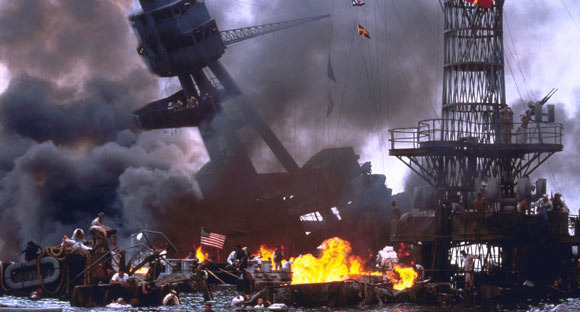
The attack scenes last about 40 minutes. If you look at just this part, you can't help but acknowledge its scale.
Especially the scenes leading to the USS Arizona Memorial hit emotionally quite hard. The problem lies in the context surrounding it.
While dealing with a historical tragedy, the way it's consumed feels too "Hollywood." Instead of evoking genuine emotion, it pushes feelings onto the audience.
This film is often compared to Titanic. The reason is simple: it follows the formula of "big history + romance = box office success."
However, the results are different. Titanic had romance woven into the story, while this film places romance on top of the narrative.
The points of criticism are clear. There is almost no perspective from the Japanese side. The complexities of war are simplified into a straightforward narrative.
Although it deals with a historical event, it doesn't significantly aid in understanding actual history. Instead, it leaves a strong emotional impression of "America went through this."
While that can't be deemed entirely negative, it's hard to consider it a balanced viewpoint.
Still, can we say this movie is completely meaningless? Not at all. Many people were introduced to the event of Pearl Harbor through this film.
And when they actually visit Hawaii, they tend to seek out places like the USS Missouri Battleship and the USS Bowfin Submarine Museum.
Ultimately, the film serves as an entry point for the public to engage with historical narratives.







 Ready to dive |
 Aura-Infused WACAM |
 Good World Good Thoughts |
 Samsung My My |
 Popcorn Popcorn Beer |
 Hawaiian Soft Tofu HASOON |
 Joyful Daily Record Blog |
 Hawaiian Dooly Mom |
 HAWAII Korean Church News |
 ANSLO NEWS |
  Wenda |
  Roman Pan |
  Nuchuhan Exploration BLOG |
  Who's watching? |
  Strawberry Pancake Warrior |
  What can make money? |
  Egg Steamed Pot |
  New Jersey News Local Stories |
  Study Abroad Life Know-How Tips |
  My Love DS |
  Leapfrog Move |
  US Regional Information Local News |
  Finding Superfoods |
  COLO COLO |
  morixa |
  nero kim |
  USA Hyundai Kia |
  OC Real Estate Business Information |
  My Town My Way Blog |
  Splendid Mission |