
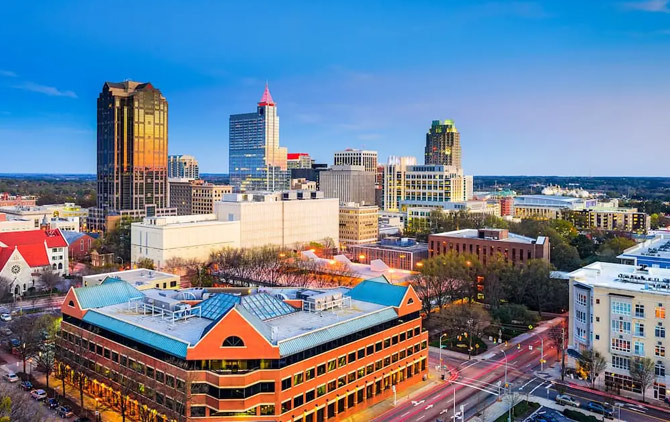
One of the hottest cities in the U.S. right now is Raleigh, the capital of North Carolina.
Just 20 years ago, this city was considered a quiet administrative center, but it has now established itself as a "livable city" with advanced industries, high-quality education, stable security, and a pleasant living environment. As a result, the population has rapidly increased in recent years, and among the interesting points is "who is moving in and from where." Actual data shows that people moving to Raleigh tend to cluster from specific states and cities.
The largest share comes from the New York and New Jersey areas.
For those living in the Northeastern metropolitan areas, Raleigh is perceived as a place where one can live with a similar level of urban infrastructure at a much lower cost. The rent for an apartment in New York could afford a single-family home in Raleigh. Moreover, since remote work has become commonplace, there is no longer a reason to stay in the expensive suburbs of New York. Financial, IT, and media professionals from New York can still work online after moving to Raleigh. Consequently, some neighborhoods in Raleigh have developed into "mini New York communities" where Northeasterners gather.
The second largest group comes from California, particularly from the San Francisco and Los Angeles areas.
California has great weather, but the housing prices and tax burdens are too high. In contrast, Raleigh offers much cheaper housing, lower taxes, and less traffic congestion. Additionally, tech companies are concentrated in Research Triangle Park, allowing those who worked in Silicon Valley to continue their careers in a similar industry structure. For these reasons, "IT talents moving from the West to the East" are flocking to Raleigh. Especially, many startup founders are establishing their companies here due to affordable office rents and a talent pool.
The third notable group comes from the Washington D.C. metro area (including Virginia and Maryland). This area has many federal government agencies and defense-related jobs, making competition fierce and the cost of living high. Therefore, middle-aged individuals nearing retirement or public servants and technical workers seeking a quieter environment often move to Raleigh. The geographical proximity, being just a 4-5 hour drive from D.C., is also an advantage.
Another interesting change is the increasing number of people moving from Florida. Previously, Florida was known as the "final destination" for retirees, but recently, there have been cases of moving to the milder and less humid Raleigh. Florida's summers are too hot, and the risk of hurricanes is high, making Raleigh a new alternative for retirees seeking a safer and more comfortable climate.
Additionally, individuals from major cities like Chicago, Boston, and Atlanta are also noticeable. The commonality is the desire to "maintain the conveniences of a big city while seeking a more relaxed life." Raleigh is right at that midpoint. It has sufficient urban infrastructure, well-equipped hospitals, schools, and cultural facilities, but with much less commuting stress and crime worries.
Thus, the people moving to Raleigh range from young tech talents to family units and retirees. Recently, there has been a notable influx of professionals in their 30s and 40s. They choose this place considering stable job opportunities, good school districts, and relatively reasonable housing prices.
As the number of immigrants increases, Raleigh's culture is becoming more diverse. The sophisticated food culture brought by New Yorkers, coffee shops and vegan restaurants established by Californians, and exhibitions by D.C. artists are all filling the area with new sensations. These changes are positively impacting the local economy, creating new businesses, increasing housing values, and revitalizing the city.
Ultimately, those moving to Raleigh today are not simply looking for a "cheaper city." They are seeking a balanced life. Raleigh is a city that offers ample job opportunities, a good environment for raising children, and conditions for comfortable living in old age.
Thus, people exhausted by the busy cities of the Northeast and the high cost of living in the West are gradually moving south to make this city their new home.








 moo moo |
 ultron78 |
 garlic bread |
 Sugar Cream Door Bulletproof Noodles |
 urbanmint |
 NC Dreamer |
 Balan |
 Audio Mania World |
 North Carolina State University |
  dralix58 |
  Gorama Round |
  Skydiving |
  dreamport |
  Yellow Snowman |
  Toaster Pizza Magic Show |
  velvetnom |
  Anytime Journey |
  Mrs. Duluth |
  jaxter |
  Atlanta Mama |
  Baguette Blog |
  US Embassy |
  Korean Mom |
  My NYC |
  Mr Oh |
  forevergee |
  festival |
  manchester |