

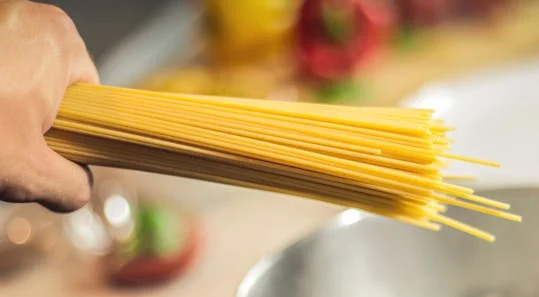
When you think of spaghetti, you probably picture long, thin cylindrical pasta, right?
As a representative dish of Italian cuisine alongside pizza, it is very popular worldwide. In fact, spaghetti originally refers to long pasta with a diameter of about 1.8 to 2.0 mm, but since it is the most commonly seen pasta both in Korea and abroad, the term "spaghetti" often feels like it encompasses all pasta.
Looking at the origin of the name, it comes from the Italian word spago, meaning "string" or "cord," which became spaghetti in its plural form from spaghetto. Moreover, the perception of pasta as a noodle dish is largely due to spaghetti. Its significant presence as long, thin pasta makes it the first thing that comes to mind when one thinks of "pasta."
The origin of pasta dates back to ancient Rome. The concept of extruding flour dough into thin strands has existed for a long time, but the form of spaghetti as we know it today was established in Italy. Particularly, the warm climate of southern Italy is suitable for drying pasta, which contributed to the significant development of dried spaghetti. Later, with the introduction of tomatoes from the New World, the culture of enjoying spaghetti with tomato sauce flourished.
Did you know that there are various types of spaghetti? In terms of pasta shapes, spaghetti, spaghettoni, and spaghettiini differ in thickness. Generally, the most commonly eaten is medium-thick spaghetti, while thinner and quicker-cooking spaghettiini is also quite common. Spaghettoni is thicker than spaghetti, providing a richer bite.
The style of spaghetti also varies depending on the sauce used. Notably, there is Neapolitan spaghetti based on tomato sauce, carbonara using cream sauce, vongole spaghetti highlighting seafood flavors, and arrabbiata for those who enjoy spicy tastes. Amatriciana, which is a mix of tomato and oil sauce, is also famous.
Nowadays, with increasing interest in health and dieting, whole wheat spaghetti and gluten-free pasta are also easily found. The texture and taste may feel a bit unfamiliar at first, but once you try it, you might unexpectedly fall for its new charm.
There are many ways to enjoy spaghetti. While tomato sauce is commonly used, American-style cream sauce spaghetti is also quite popular in Korea. Additionally, pesto sauce made with basil and olive oil is used, and there is even oil spaghetti that utilizes olive oil as the sauce. Therefore, you can always find spaghetti on the menu at most Western-style restaurants, right? With a wide variety of sauce options, the choices are quite broad.
However, a characteristic of authentic Italian carbonara is that it is rarely seen in Korea. The "cream-laden" carbonara that we commonly know is actually quite different from the original. Authentic carbonara is made only with eggs, cheese, and ingredients like pancetta or guanciale, creating a rich flavor without cream. Thus, if you make it in the Italian style, you might find it "dry and rich." However, these days, restaurants serving authentic carbonara are increasing, making it easier to taste not only in Seoul but also in the outskirts of the metropolitan area. Some places even sell "carbonara" and "cream pasta" separately.
In conclusion, spaghetti is the most popular representative of pasta and is a dish that can be transformed with various sauces and styles. When making it at home, using different ingredients to create sauces according to your taste gives it a much more special feel. If you have only tried one style of spaghetti, I encourage you to challenge yourself with various sauce combinations or authentic methods. You will surely discover a different charm.






 Moscow Kim |
 Seattle - Emerald City |
 self-evaluation |
 Sandiego Auntie |
 Karina's Blog |
 Cherokee Rose |
 Dingho and USA News |
 moonshine 7 |
 Gimmi207 Blog |
 Korean Mom |
  My NYC |
  moo moo |
  Mr Oh |
  forevergee |
  festival |
  manchester |
  constant |
  Leapfrog Move |
  vibranto |
  Tora Tora |
  yellowbutter |
  Dolly |
  US Embassy |
  NYC saladbar |
  Finding Superfoods |
  lightyear |
  song bang |
  vexomo |
  Indiana Jones |