

Everyone, there are hidden side effects to your plane ticket to the U.S.
The moment you pass through the gate at Incheon Airport, the 'unfounded confidence' hormone surges explosively through your veins.
By the time you land at the airport in the area you've chosen to live in the U.S., you're already imagining yourself as a cover model for Forbes.
"Who am I? I'm someone who worked 3,000 hours of overtime in Korea," you say, puffing out your chest.
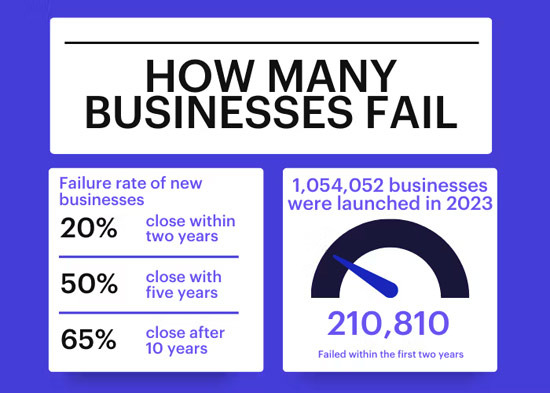
But the problem is that the five-year survival rate for startups in the U.S. is over 50% likely to end in failure.
According to the Bureau of Labor Statistics, the survival statistics for new businesses are as follows:
1-year survival rate: about 80%
3-year survival rate: about 50-60%
5-year survival rate: about 45-50%.
This isn't pessimism; it's just a fact. A bitter fact.
"If I do it, it will be different?"
The Korean spirit of hunger is indeed great.
Waking up at 4 AM and finishing work at midnight takes a lot of mental strength.
But do you know what happens if you treat your employees like that in the U.S.? You'll receive a complaint from the labor department.
And the sadder thing for hardworking Korean business owners is their blind faith in their own products.Even when the market signals three times that "this won't sell," they pour water into a bottomless pit, insisting, "My product is special."
What matters is not the numbers but the trends.
Initial confidence → Market structure shock → Financial pressure → Failure to adjust direction
If you follow this route, the speed at which you close your business is faster than you think.
Later, you'll find yourself with a lot of work and an empty bank account.

Another common misconception: "K-Town is the easiest place to be"
This is a trap that immigrant entrepreneurs easily fall into.
It's the Korean town black hole.
Instead of tapping into the vast U.S. market of 300 million people, they insist on starting a business targeting only Koreans.
And they only aim for people living within a 3-mile radius of their store.
The result? A bloody competition with Mr. Kim next door, Mr. Park across the street, and Mr. Lee across the way, all fighting over a bowl of sundae soup for a 50-cent discount.
The saying, "If we stick together, we'll be fine," is warm. But as you stick together, you'll realize at some point.
We're sticking together and failing together.
Information is also limited. If information only circulates within the Korean community, mainstream trends, legal changes, and VC funding flows become "stories from another country."
You may not know what's happening in Silicon Valley right now, but you know in real-time which college the neighbor's son got into.
Is this normal?
Are you serious? "As long as I have skills, that's enough." Yes, skills are enough.
The problem is how you explain that you have skills. Ninety percent of business in the U.S. is pitching and networking.
If you can't communicate, that's a sign of lacking skills. It's harsh but true.
"Good is good enough"
The Korean mentality of "quick quick" is amazing. But when you come to the U.S., it becomes a hidden danger.
"Mr. Kim, let's go into business together. A contract? Oh, we don't need that between us."
Six months later: "I've hired a lawyer. See you in court."
In the U.S., there is one lawyer for every 300 people.
If you expect Korean culture, you'll find yourself not only disappointed but also losing your entire fortune.
A verbal agreement? If it's not documented in an email, it doesn't exist. A handshake? It's just exercise.
Skipping market research is also a fatal mistake. They bring over an item that was a hit in Korea.
But Americans don't eat 12 side dishes. Even if you give them two, they'll say, "That's too much; I left some behind."
Logistics, rent, labor costs, and tax structures are all different.
You'll experience the magic where a 30% profit margin in Korea turns into a -10% margin here.
How to survive: Shout every morning, "I could fail too"
Do you know what the common trait of successful Korean entrepreneurs in the U.S. is?
They maintain the diligence of Koreans but have completely adopted the mindset of Americans.
- They show contracts to lawyers two or three times
- They spend generously on market research and marketing
- They steadily step outside of K-Town
- They know how to admit, "I could be wrong"
- When failure signals arise, they set aside their pride and look for new directions
The U.S. is a harsh but honest land. It rewards effort and makes you suffer for being careless.
Don't think, "There's no way I'll fail." Instead, think, "I could be one of those who fail."
The land of opportunity only opens its doors to those who face their weaknesses head-on.
The rest quietly go out of business.
Are you now a bit more prepared to work hard out of concern?
That humility is the very beginning.







 coloradoman |
 Living Economy Information Blog |
 Tomato Health Club blog |
 Banana Style Life |
 crystalo |
 Nationally Certified Lightning Charcoal Review |
 Northeastern |
 American Grape Shine Muscat |
 U.S. Weather Bureau News |
 sparkling |
  Finding Superfoods |
  lightyear |
  song bang |
  vexomo |
  Indiana Jones |
  meloncat |
  novapixel |
  mortrix |
  Esther 1983 |
  fortbliss |
  Moscow Kim |
  My Two Way |
  toastyfox |
  FLORIDA Acus |
  tracker |
  TONTON COFFEE |
  sunrise |
  ultron78 |
  uplifted |
  Folding Instructions |