

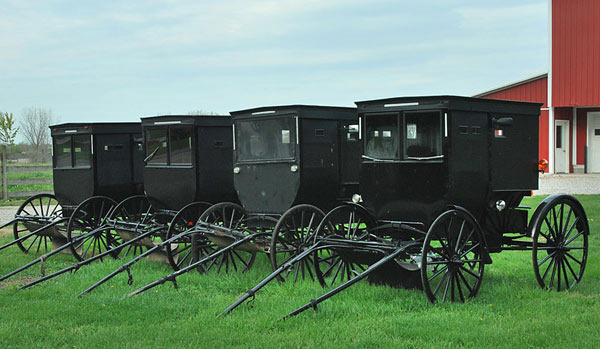
The Amish people are truly fascinating. They live like the village of Cheonghak-dong in Korea, distancing themselves from modern civilization, not using electricity, riding horse-drawn carriages, and wearing old-fashioned clothes, creating another world within 21st century America.
However, when you actually meet them, you find that many are surprisingly warm and cheerful. They may not be as flashy as city dwellers, but their eyes are calm and their speech is gentle. They are not reclusive individuals avoiding the world, but rather people who continue to live a 'simple and honest life' in the way they believe is right.
The Amish originally hail from southern Switzerland and Germany in the 17th century. At that time, the Anabaptists emerged, claiming that 'baptism should be decided by adults themselves,' and among them, a leader named Jakob Ammann separated to form the Amish. Their name comes directly from him. They chose to live centered around faith and community instead of the conveniences of the secular world; they are the Amish. However, due to severe religious persecution in Europe, many crossed the Atlantic to America in the early 18th century, with Lancaster, Pennsylvania, becoming their first settlement.
As time passed, they spread across the United States, and now there are over 400,000 across 30 states. Interestingly, their numbers continue to grow steadily. Farming without machinery requires a lot of hands, and since they do not practice contraception, the average birth rate is over six children. The population, which was just over 5,000 in 1920, grew to 350,000 by 2020. This means it has increased 70 times in a century. At this rate, it is said that by 2050, there could be over 900,000. While the world is struggling with declining birth rates, the Amish are actually experiencing 'population growth.'
When people think of the Amish, they usually think of Pennsylvania, but recently, southern Virginia is emerging as a new center. Families that migrated from Delaware and Pennsylvania around 2005 have settled in places like Halifax County and Nathalie. The reasons they chose this area are very practical. First, land prices are low. While farmland in the northern regions has become expensive due to development, southern Virginia is still quiet and has ample land. Second, it is peaceful. For the Amish, 'quietness' is not just a simple environment but a part of their faith. They desire a life of working the fields with family and helping neighbors instead of the noise and competition of the city. Third, the attitudes of the local people are warm. Virginians generally have a relaxed and respectful atmosphere, making it easy for the Amish, as outsiders, to blend in.
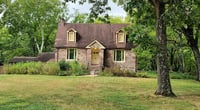
When you visit an Amish village in Virginia, you see white fences lining the dirt roads and farms with parked carriages. The neighborhood has almost no power lines, so at night, it feels like the stars are pouring down. Occasionally, you might see one or two houses with electric lines connected, but those belong to ordinary residents, not the Amish. In fact, there are hardly any 'villages solely inhabited by Amish.' They mingle well with ordinary people and sell vegetables they grow or furniture they make. However, since they do not use electricity, have no internet, and travel by carriage instead of cars, they naturally live a bit distanced from city dwellers.
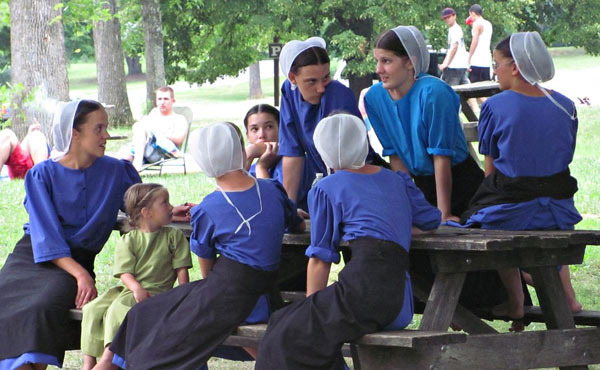
The reason the Amish settled in Virginia is not just because it is quiet and the land is cheap, but because they sought the freedom to live in the way they believe. As the world becomes faster and more complex, they still carve wood by hand and sit around the table with family to give thanks. Like an 'island where time flows slowly,' the Amish village in Virginia shows that a human life is still possible within modern America.
In Amish society, when a village grows beyond a certain size, some families naturally move to a new location to create another community. Even as the population increases, they do not respond with technological advancement or urbanization; instead, they choose to expand their land and divide their community. For this reason, Virginia has attracted attention as a new settlement candidate, and in less than 20 years, it has grown into a solidly sized community.
The Amish in Virginia still maintain traditional lifestyles. They do not use electricity, travel by carriage, and their children only attend school until the 8th grade. However, they are not simply isolated. They contribute to the local economy through various livelihoods such as woodworking, furniture making, selling agricultural products, and operating sawmills.
In particular, the production of handcrafted wooden buildings or sheds is a specialty of the Amish, and they are highly trusted throughout Virginia under the name 'Amish Shed.' The barns made by Amish craftsmen are structurally strong and finely finished, distinguishing them from local general contractors.
Ultimately, the reason the Amish settled in Virginia is not simply because they found a 'quiet place,' but because they wanted to uphold their principles of life and not lose their essence amidst the changes of the times. Even in an era overflowing with advanced technology, they continue to carve wood by hand and live by working the fields with their families. The Amish village in Virginia is living proof that such a life is still possible.




 Virginia Butterfly Mom |
 victoria jung |

 Margarine Daebimama |
 monica hong |
  Tonky |
  viroma |
  cookie |
  Live and that's it |
  Alright Twain |
  eatontown blog |
  HAWAII Korean Church News |
  Amore |
  linex |
  Balancework |
  laro90 |
  MEDBIO American Doctor Blog |
  SWAT TEAM BLK |
  DREAM BIG |
  frostbite |
  330 Forever My Love |
  El Dorado |
  dralix58 |
  Gorama Round |
  Skydiving |