
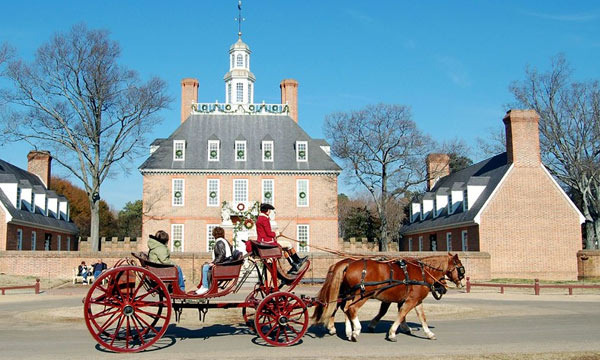
Williamsburg, Virginia, is a city that gives the feeling of embarking on a journey through time.
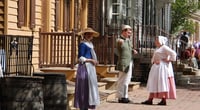
The first thing I felt when I set foot there was 'tranquility.' The buildings are low, carriages instead of cars travel the roads, and the clothes people wear are even from the 18th-century colonial period. It feels like a movie set, but this is the real historical site where the foundations of America were laid.
The heart of the city is the old town known as 'Colonial Williamsburg.' It was the capital of Virginia from 1699 to 1780, perfectly recreating the atmosphere of the time when the colonial government operated under the influence of the British crown. As you walk down the streets, soldiers in uniforms march, the sound of hammers rings out from the blacksmith's shop, and the sound of violins can be heard around the corners. Rather than a tourist spot, it feels like being invited to a small town where time has stopped.
The first place I visited was the 'Governor's Palace.' This was the residence of the British governor during the colonial period, grand yet intricate. Passing through the entrance, weapons gleamed on both walls, and a long table used by the nobility of the time was laid out on the red carpet. The guide mentioned that this was not just a residence but also a political space showcasing 'the majesty of the king.' The garden visible from the window was neatly arranged in a symmetrical structure, and at the end of the path stood a sign that read 'The Beginning of Freedom.' Ironically, the spirit of American independence sprouted right next to the house of the king's representative.
As I left the palace and walked towards Bruton Parish Church, candles shaped like light bulbs were lit on every street lamp. A horse-drawn carriage passed through the alley bathed in afternoon sunlight, and children waved their hands with smiles. The church, built in 1715, still holds services today. Knowing that George Washington and Thomas Jefferson once worshipped here, a strange feeling washed over me as I entered.
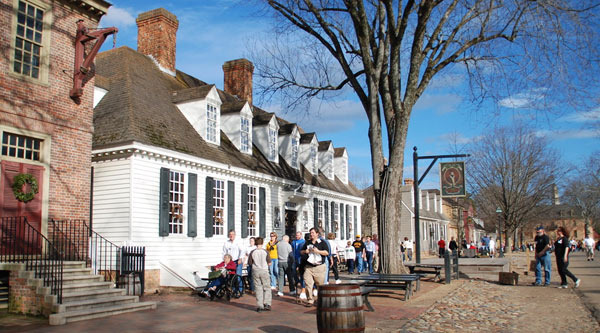
For lunch, I dined at the 'King's Arms Tavern,' restored to resemble an 18th-century tavern. Traditional soup, pie, and warm apple cider were served on a wooden table lit by candlelight. The waiter, dressed in period attire, smiled as he explained the menu, saying, "This is a recipe from the 1770s." The food was neat, and as I ate, imagining what the atmosphere of the table would have been like for people of that era, I felt the boundaries of time blur for a moment.
In the afternoon, I headed to the colonial capitol building. Inside the red brick building were wooden benches and candlesticks, and the guide explained, "The passionate debates of Virginia's delegates discussing independence here shaped today's America." In fact, this place is one of the foundations where the U.S. Constitution was established, and many students still come here as part of their history lessons.
As dusk fell, the streets of Williamsburg were bathed in golden light. The sound of carriage wheels on the cobblestones echoed like a rhythm, and a musician played the flute in front of a shop. People walked slowly to the music, and no one was in a hurry. The entire city felt like it was standing on 'the opposite side of speed.'
Williamsburg is not just a tourist destination. It is 'the stage where America was born.' In the colonial era under British rule, it was here that those dreaming of freedom and independence debated all night, marking the beginning of today's democracy. Therefore, I feel that the air here carries not just nostalgia but also the 'heat of beginnings.'


 Virginia Butterfly Mom |
 Cool Beach Freeway |
 Next Year, Let's Become Rich |
 travelo |
 US Embassy |
  Korean Mom |
  My NYC |
  moo moo |
  Mr Oh |
  forevergee |
  festival |
  manchester |
  constant |
  Leapfrog Move |
  vibranto |
  Tora Tora |
  yellowbutter |
  Dolly |
  NYC saladbar |
  Finding Superfoods |
  lightyear |
  song bang |
  vexomo |
  Indiana Jones |