
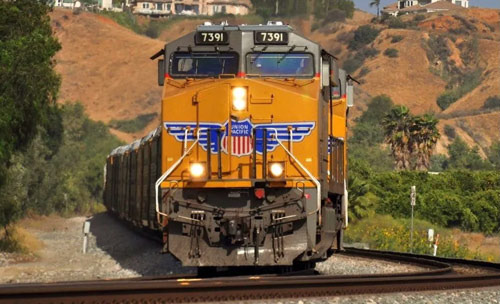
Currently, the United States is one of the countries with the largest railroad networks in the world, with a total length of about 140,000 miles, which is approximately 225,000 kilometers.
Most of this is occupied by freight railroads, while passenger railroads have a relatively small share.
Major railroad companies that you might recognize, such as BNSF, Union Pacific, CSX, and Norfolk Southern, lead the industry. Regionally, the Midwest and East have dense rail networks, while the West has a more sparse layout due to the vast land and challenging terrain.
Looking back at history, the beginning of US railroads dates back to the 1820s and 1830s. The establishment of the Baltimore and Ohio Railroad in 1827 marked the start of commercial railroads. The first section was completed in 1830, and the goal was simple: to connect Baltimore with the Ohio River to facilitate logistics. Initially, it was used as a means to complement rivers or canals, primarily transporting agricultural products and raw materials to markets.
Then, in the 1860s, a major project called the Transcontinental Railroad was launched.
With the passage of the Pacific Railroad Act in 1862, the government provided land and funding, allowing for the connection of the East and West by rail. In 1869, a historic moment occurred when Union Pacific and Central Pacific met at Promontory Point in Utah. This marked the beginning of accelerated westward expansion and economic integration.
From the 1880s to the 1920s, the railroad network expanded explosively, known as the golden age of railroads.
By the 1880s, there were over 93,000 miles of track laid, connecting cities and rural areas and linking the East and West, significantly boosting the US economy. At that time, railroads were central not only to freight but also to passenger movement, benefiting agriculture, livestock, mining, and manufacturing.
However, the atmosphere changed starting in the 1930s. With the rapid growth of automobiles and airplanes, passenger railroads gradually lost their competitiveness. Especially with the creation of the highway system and the increase in air travel, railroads were pushed aside.
While freight remained important, the rise of truck transportation and container logistics reduced its share. Ultimately, in 1971, the federal government established Amtrak to maintain passenger rail service, taking over the passenger sector that private railroad companies had abandoned and operating it nationwide.
Since the 1980s, there have been signs of a railroad revival.
With the introduction of container logistics and efficient transportation technologies, freight railroads gained attention, showing strong competitiveness in transporting bulk goods like coal, grain, and automobiles. Recently, projects like the California High-Speed Rail have been promoted, and Amtrak is being highlighted again as an environmentally friendly mode of transportation.
The impact of railroads on American society is truly significant.
Economically, it accelerated industrialization and urbanization, enabling the efficient movement of agricultural products and resources, which facilitated national economic integration. Socially, it promoted the movement of immigrants and westward expansion, serving as a medium that connected regional cultures. Politically, it played a crucial role in the federal government's management of vast territories and in mediating conflicts with Native Americans.
Ultimately, while US railroads were once a symbol of westward expansion and economic growth, they are now being recognized again as the future of freight transportation and eco-friendly transit.







 Weekend Movie Blog |
 Beauty, Health, Lifestyle Blog |

 coloradoman |
 Superman Cat Blog |
 novapixel |
  Tonky |
  viroma |
  cookie |
  Live and that's it |
  Alright Twain |
  eatontown blog |
  HAWAII Korean Church News |
  Amore |
  linex |
  Balancework |
  laro90 |
  MEDBIO American Doctor Blog |
  SWAT TEAM BLK |
  DREAM BIG |
  frostbite |
  330 Forever My Love |
  El Dorado |
  dralix58 |
  Gorama Round |
  Skydiving |