
Anchorage is a representative city of Alaska, serving as a center for economy, culture, and transportation. The city's name originates from the past when ships docked at the mouth of Ship Creek, meaning 'the place where an anchor is dropped.' This origin of the name reflects the history of Anchorage, making it fascinating.
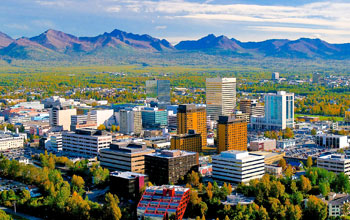
Currently, the population of Anchorage, including the urban and suburban areas, is about 380,000, establishing it as the overwhelming number one city that accounts for more than half of Alaska's total population. Considering that the total population of Alaska is about 730,000, it is clear how important Anchorage is as the center of the state.
Anchorage is also famous for its unique landscape where nature and the city harmonize. The majestic mountain ranges surrounding the city and the wildlife that can be encountered at close range provide a special experience for many travelers. Additionally, Anchorage serves as a gateway to Alaska, hosting major ports and airports, playing a crucial role as a hub for logistics and tourism.
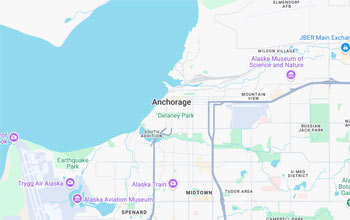
Geographical Location and Importance: Due to its proximity to the Arctic Circle and its location on the Pacific coast, Anchorage has historically been utilized as a military and logistics hub.
Cultural Diversity: The diverse culture formed by people from various backgrounds, including Alaska Native cultures, stands out.
City Life in Nature: Outdoor activities such as trekking, fishing, and skiing can be easily enjoyed around the city, making it particularly loved by nature enthusiasts.
Transportation Information
Anchorage Ted Stevens International Airport is located 10 km south of Anchorage. It was considered an essential stopover for trans-Pacific flights during the Cold War, supported by Alaska Airlines. Now, due to advancements in aircraft performance and improved relations with Russia, there is no longer a need for stopovers, but cargo planes frequently arrive, including Korean Air cargo flights to Anchorage.
Additionally, it is a busy airport with many flights to various parts of Alaska. Direct flights from Asia, including Japan and China, have all been eliminated, so traveling from South Korea typically requires a transfer in Seattle, USA.
Although there are connections to U.S. state roads, they pass through Canadian territory. To drive to Juneau, the capital of Alaska, one must go through Canada, even though it is still within Alaska. The Alaska Railroad runs through Anchorage, connecting to southern destinations like the Alaska ferry port of Whittier.
Being the northernmost part of the United States and close to the Arctic, it is cold here. In January, the lowest temperature recorded was minus 30 degrees. However, it is not always cold, as the daytime temperature reached 32.2 degrees on July 4, 2019. This record should be considered in light of climate change. From November to February, it is a cold winter, and sometimes it can be cold throughout March. Generally, March and October are early winter, while April to September have cool weather. However, while winter is longer than in Korea, it is said that the temperatures are not unmanageable for Koreans.
Due to its high latitude, the phenomenon of the midnight sun occurs in summer. In June, the sun sets at 11 PM and begins to rise at 2 AM, so people block their windows to keep the indoors dark while sleeping. In winter, the opposite occurs, with the phenomenon of polar night making it dark all day long.
Main Korean Websites in Anchorage, Alaska
Korean Association of Anchorage, Alaska







 AL ALASKA |
 Information on Area Codes in the Americas |

 Alaska Kim |
 Omelet Rice for Strength |
  laro90 |
  MEDBIO American Doctor Blog |
  SWAT TEAM BLK |
  DREAM BIG |
  frostbite |
  330 Forever My Love |
  El Dorado |
  dralix58 |
  Gorama Round |
  Skydiving |
  dreamport |
  Yellow Snowman |
  Toaster Pizza Magic Show |
  velvetnom |
  Anytime Journey |
  Mrs. Duluth |
  jaxter |
  Atlanta Mama |
  Baguette Blog |
  Tan Sol |