

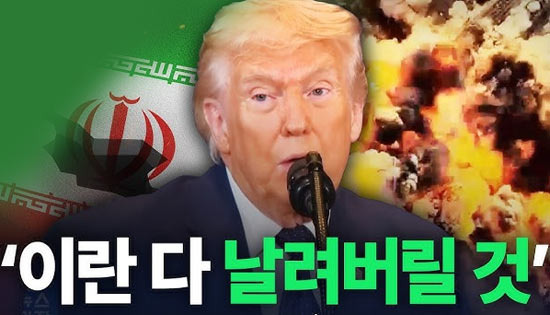
President Trump has extended the deadline for an attack on Iran three times, and once again has presented a 'final deadline,' marking a significant turning point in the Middle East situation.
During a press conference on the 6th, President Trump made it clear that this deadline is final.
The fourth ultimatum is set for 8 PM on the 7th.
All eyes are on whether negotiations between the U.S. and Iran will conclude by this time or if military conflict will escalate.
He mentioned that if negotiations do not take place, he could take strong military action against Iran's key infrastructure.
He emphasized that major facilities such as bridges and power plants could be targets, raising the level of pressure.
Regarding the controversy over attacking civilian infrastructure under international law, he stated that Iran's nuclear development itself poses a greater threat.
The core of the negotiations currently focuses on establishing an immediate ceasefire and reopening the Strait of Hormuz as the first step, followed by comprehensive negotiations that include nuclear issues and sanctions relief leading to a peace settlement.
However, Iran has reportedly rejected this proposal, demanding a complete lifting of sanctions, security guarantees for the Strait, and reconstruction support.
Ultimately, the biggest point of contention in the negotiations is the issue of the Strait of Hormuz. Whether it will be blocked or not directly impacts international oil prices and maritime logistics.
However, the outlook for negotiations is not optimistic. U.S. negotiators have analyzed that it will be difficult to narrow the differences in positions by the deadline, and it has been reported that military options are being considered as a realistic scenario internally.
Iran is also maintaining a skeptical attitude toward the negotiations. Trust has been significantly damaged due to past instances where military actions were conducted alongside negotiations, and military tensions continue to persist.
The mediation process is also not smooth. Egypt, Turkey, and Pakistan are attempting to coordinate through diplomatic channels, but Iran's internal communication infrastructure has been significantly damaged, making the negotiation channels themselves unstable. President Trump also acknowledged this point, admitting that communication between the two sides is very limited.
If an agreement is not reached by the deadline and military action is carried out, the subsequent situation will become even more unpredictable.
Even if the U.S. achieves military success, there is a high possibility that Iran will maintain its strategic means of blocking the Strait of Hormuz. This could lead to long-term uncertainty in the international energy market and maritime trade.
Ultimately, this deadline is seen not just as a simple negotiation cutoff but as a crucial benchmark determining whether tensions in the Middle East will ease or escalate into a new phase.







 novapixel |
 NEXT ROUND |
 Encyclopedia of New York and Surrounding Areas |
 washington mom |
 California Dreamer |
 American Grape Shine Muscat |
 Your Curiosity Resolved |
 Pennsylvania Aunt |
 Information on All Regions of the United States |
 American General Knowledge Expert |
  Cap Com |
  nixxon |
  kevin Kim |
  beerdreamer |
  Kims Spring |
  White bunny |
  Kansas City Representative Singer |
  shadow 007 |
  sun walker |
  Choco Choco Star |
  midnight blue |
  honeypot |
  summer |
  adventure77 |
  flexible |
  Shintongbangtong Shin Naerin James Park |
  truepixel |
  Kathy's Blog |
  Hae Naem |
  quatspace |