

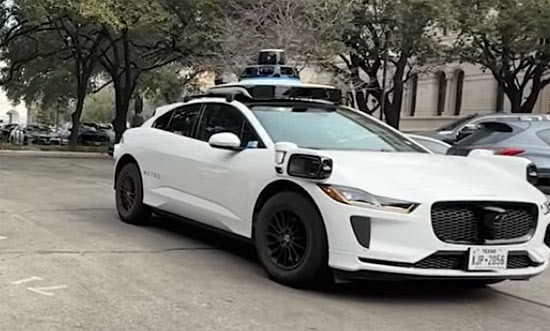
Living in San Antonio, news about air taxis, robots, and driverless taxis often feels like stories from other cities.
That's because they usually start in places like LA, San Francisco, or Austin.
So whenever I heard about Waymo's driverless taxis, I thought it was just something happening elsewhere.
However, starting February 24, Waymo has officially begun commercial operations in San Antonio, Dallas, and Houston.
This is not just a rumor; the actual service has started. Now, it's definitely a local story.
Currently, the service is still operating on a limited basis. Only a select group of invited users can access it, while the general public must register on a waiting list through the Waymo or Uber app.
The operational area is still limited to downtown San Antonio, and it does not include highways or interstates.
In short, it's not suitable for long-distance rides. How can you get anywhere if you can't use the freeway? Haha.
Still, the vehicles are fully autonomous, and there is no one in the driver's seat.
Passengers can open the doors and adjust the temperature or music settings directly through the app.
From Waymo's perspective, Texas offers a very favorable environment. The roads are wide, the weather is stable, and regulations are relatively flexible. Since they already have operational experience in Austin, expanding to major cities like San Antonio, Dallas, and Houston is a natural progression.
In particular, the partnership with Uber is a crucial strategy. The ability to hail Waymo vehicles through the Uber app means they can absorb existing users. Since it can be used without installing a separate app, the expansion speed could increase significantly.
Many people are most curious about safety.
According to data, there are many evaluations suggesting that it is more stable than human drivers. There are no sudden brakes or speeding, traffic signals are followed accurately, and there are no variables like fatigue or intoxication.
However, there are unique environmental variables in Texas. There are many large pickup trucks, and sometimes you see drivers behaving erratically, so it's still hard to say it's perfect. This is why they are currently operating mainly in downtown and not entering highways.
Economically, it could significantly impact Uber and Lyft drivers. If drivers are no longer needed, the cost structure itself will change. In the long run, there may come a time when a cost comparison is made between maintaining a personal vehicle and using robo-taxis.
Personally, I view this technology positively. The reason is that it is actually functioning in the market.
The technology has developed sufficiently, and there is demand, so it is naturally expanding.
Of course, there are issues that need to be addressed. Questions of liability in the event of an accident, insurance structures, and data privacy will need to be sorted out in the future. Many analyses suggest that Texas was the first to adopt this due to its relatively flexible regulatory environment.
In conclusion, Waymo is no longer a distant future technology but a change that has already begun around us.
Now, it wouldn't be a bad idea to take an interest and experience it for yourself. Of course, you'll need to apply for the waiting list.






 Anjollinya Blog |
 Taco Seattle |
 Mr Song Song |
 Living Economy Information Blog |
 Blog Korea |
 solvix18 |
 Coding Elf |
 action blog 101 |
 Hajiwon Blog Hair Salon |
 Idaho's Sumi's House |
  Mr. Midwest America |
  wildfire |
  kerkee |
  legalway |
  postcard |
  cheesecake07 |
  My Miami Stories |
  windylotus |
  Mia Flori |
  velaro29 |
  velaro |
  foxtrot83 |
  moname |
  mapleline |
  US Legal Consultation on Trials |
  UNI Lover |
  Karina's Blog |
  California Dreamer |
  Choco Mint Creator |