
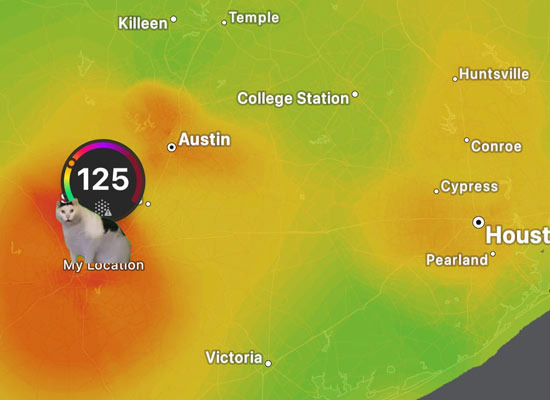
The most common question when discussing air quality in San Antonio is whether the AQI is among the best in the U.S.
AQI stands for Air Quality Index, which is a measure that shows how good or bad the air is for human health in numerical form.
A lower number means cleaner air, while a higher number indicates more pollution.
Generally, an AQI of 0 to 50 is classified as 'good', meaning that children and the elderly can engage in outdoor activities without significant issues.
An AQI of 51 to 100 is considered 'moderate', which usually does not affect most people, but sensitive individuals may experience slight discomfort.
Once the AQI exceeds 100, caution is advised. Particularly for those with asthma or weak respiratory systems, it is better to limit outdoor activities.
San Antonio typically has an AQI ranging from 30 to 60, making it one of the cities with good air quality in the U.S., but it is not always ranked at the top.
Overall, the air quality is above average, and it is rare to see smog like in California's LA or to have days filled with haze.
There are many days with good winds, so the air does not linger in one place for long.
As a result, the AQI often stays between 'good' and 'moderate', and days when children need to be restricted from outdoor activities are uncommon.
However, it is not always perfect. Occasionally, there are days when the AQI spikes, usually due to large wildfires in the southern Mexico border region. If the wind direction is right, smoke and fine dust can travel up to central Texas. During these times, the sky may appear slightly hazy, and some people may feel a scratchy throat.
While not common, experiencing this once or twice can lead to the realization, "Ah, this is the effect of that." Still, this is more of a temporary phenomenon caused by winds rather than a problem specific to San Antonio.
Another common point of confusion is whether San Antonio is a basin. In conclusion, it is not.
San Antonio has generally gentle terrain, and while it does rise slightly towards the Hill Country, it does not have a bowl-like structure that would trap air. Although there are low-lying areas along the San Antonio River, it is far from the concept of a basin covering the entire city.
Thus, there are many days when the air escapes rather than stagnates. For this reason, San Antonio is often mentioned as a city with good air quality to live in, but it does not always rank first.
As long as one is cautious on days when smoke from wildfires in Mexico comes over, it is a city where air quality does not cause much stress in daily life.







 Helpful Life Stories |
 American Man in a Mask |
 Hajiwon Blog Hair Salon |
 Make My Day |
 TEXAS Fishing Boat |
  DREAM BIG |
  frostbite |
  330 Forever My Love |
  El Dorado |
  dralix58 |
  Gorama Round |
  Skydiving |
  dreamport |
  Yellow Snowman |
  Toaster Pizza Magic Show |
  velvetnom |
  Anytime Journey |
  Mrs. Duluth |
  jaxter |
  Atlanta Mama |
  Baguette Blog |
  Tan Sol |
  US Embassy |
  Korean Mom |
  My NYC |